Bread of Life, Part 3

Thirteenth Sunday after Pentecost (Proper 15, Year B)

Almighty God, you have given your only Son to be for us a sacrifice for sin, and also an example of godly life: Give us grace to receive thankfully the fruits of his redeeming work, and to follow daily in the blessed steps of his most holy life; through Jesus Christ your Son our Lord, who lives and reigns with you and the Holy Spirit, one God, now and for ever. Amen.

John 6:51-58


Jesus said, “I am the living bread that came down from heaven. Whoever eats of this bread will live forever; and the bread that I will give for the life of the world is my flesh.”


The Jews then disputed among themselves, saying, “How can this man give us his flesh to eat?” So Jesus said to them, “Very truly, I tell you, unless you eat the flesh of the Son of Man and drink his blood, you have no life in you. Those who eat my flesh and drink my blood have eternal life, and I will raise them up on the last day; for my flesh is true food and my blood is true drink. Those who eat my flesh and drink my blood abide in me, and I in them. Just as the living Father sent me, and I live because of the Father, so whoever eats me will live because of me. This is the bread that came down from heaven, not like that which your ancestors ate, and they died. But the one who eats this bread will live forever.”


Faith from the Margins to the Web Authors: Mary, Willie and Charles

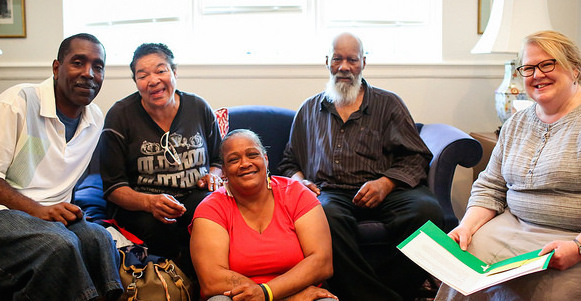
Mary, Willie, and Charles are regular attenders of the weekly healing prayer service and feeding program of a local Episcopal church. All three are now older adults who live a short walk from the church; all three have experienced homelessness in their own lives, families, and communities.

We gathered as a small group to discuss the lectionary readings for the 11th, 12th, and 13th Sundays after Pentecost, which pivot around this central point: “I am the bread of life. Whoever comes to me will never be hungry, and whoever believes in me will never thirst.” This is the third and final week that we’ll hear from this group.

Our conversation turned to the idea of Jesus as “The Living Bread” and how that image might help us better understand our relationship with God, and each other.

“We’re all God’s children” said Mary. “Especially children and old folks. Sometimes we feel like we’re on the outside of all that is happening. I used to be a CNA, until I hurt my back, lifting before we had all the technologies to help with that. There was a lot of help that people needed and they felt outside, cast out.  My job wasn’t just to lift them but to help them feel inside and welcomed.  I think that is what Jesus wants to do.  To be the living bread that helps us feel like we are inside.”

“That’s right” said Willie, “and when we are on the outside, its hard to feel like you belong, you know, like you’re really family.  It might be the thing that people need the most.  When we take in Jesus, we begins to see that we ARE family, and to want to treat each other the way we would want to be treated.”

“Treat people like you would treat your own” said Charles.

“See, I was from the country, and we were used to taking care of family” explained Mary.  “People who I took care of when I was a CNA, they often felt on the outside of their families. So, I spent time not just doing for them, but helping them know that they were loved, that they were family.  It’s the way that we should be towards each other, and I think Jesus knew that.  Jesus loves us, so we can be the ones to share that love.  That’s what he means by being the Living Bread.”

“Yes! It isn’t just doing what needs to be done, but doing it with love and care, treating each other like family. And if we’re all the people of God, then that means we need each other” said Willie.

This is food for thought for all of us who engage in ministries of feeding, helping, and hospitality. We can so easily get caught up in the mechanics and logistics of what is needed: food, shelter, physical care. But, there is a need for family and community which flows from these ministries. When we walk as Jesus walked, and feed as Jesus fed, we are not merely responding to physical hunger or caregiving. We are sending a message that together, we are one family. In our sharing…not in spite of, but with full awareness of our differences…we live into that possibility of being one family together. God’s presence is made known in us.

Mary closed the group with a prayer of thankfulness for this family that gathers in the name of Jesus, the Living Bread who draws us all near as beloved family.
 

bread in hand

Bread of Life (Part 2)

Twelfth Sunday after Pentecost (Proper 14, Year B)

Grant to us, Lord, we pray, the spirit to think and do always those things that are right, that we, who cannot exist without you, may by you be enabled to live according to your will; through Jesus Christ our Lord, who lives and reigns with you and the Holy Spirit, one God, for ever and ever. Amen.

John 6:35, 41-51
Jesus said, “I am the bread of life. Whoever comes to me will never be hungry, and whoever believes in me will never be thirsty.”


Then the Jews began to complain about him because he said, “I am the bread that came down from heaven.” They were saying, “Is not this Jesus, the son of Joseph, whose father and mother we know? How can he now say, ‘I have come down from heaven’?” Jesus answered them, “Do not complain among yourselves. No one can come to me unless drawn by the Father who sent me; and I will raise that person up on the last day. It is written in the prophets, ‘And they shall all be taught by God.’ Everyone who has heard and learned from the Father comes to me. Not that anyone has seen the Father except the one who is from God; he has seen the Father. Very truly, I tell you, whoever believes has eternal life. I am the bread of life. Your ancestors ate the manna in the wilderness, and they died. This is the bread that comes down from heaven, so that one may eat of it and not die. I am the living bread that came down from heaven. Whoever eats of this bread will live forever; and the bread that I will give for the life of the world is my flesh.”


Faith from the Margins to the Web Authors: Mary, Willie and Charles
Mary, Willie, and Charles are regular attenders of the weekly healing prayer service and feeding program of a local Episcopal church. All three are now older adults who live a short walk from the church; all three have experienced homelessness in their own lives, families, and communities.

We gathered as a small group to discuss the lectionary readings for the 11th, 12th, and 13th Sundays after Pentecost, which pivot around this central point: “I am the bread of life. Whoever comes to me will never be hungry, and whoever believes in me will never thirst.” We’ll hear from the authors of this group for the next few weeks.

The group began to talk about the ways that we break bread together:

“Eating, breaking bread is what we do with family. It’s something special that I see” said Willie. “We get together at a table, we break bread and as the meal goes we have conversation. We share stories and get to know each other.”

“It’s like family” said Mary. “We feed each other, we eat, we talk and we learn to love each other.”

“And in this part of the passage, Jesus refers to his Father while the Pharisees are criticizing him because they can’t imagine someone holy could come from his human family.”

Willie continued, “The people I know, the friends that I have I’ve often made from eating together. Like when we come here, and we sit with people some of them we know, and some we don’t know.  But we get to know them, and it’s like we become family.  It isn’t just about the food we put in our mouths. It’s the community that happens around the table.  Maybe this is what Jesus meant, in the sharing of the bread with each other we become family.”

This made me reflect a little to the group “You know, your conversation is giving me a whole new meaning on Jesus dining with sinners and tax collectors, too, like we hear throughout the Gospels. It wasn’t just ‘oh, I’ll eat with these people, too’ to prove a point; it was saying in action, ‘we are one family.’ It is less about what we do, and more about the fact that we are there, in the company of Jesus. We are known, and loved and belong and that changes us.”

“Bringing us all together” said Willie.  “That’s it.  Bringing us all together.  It isn’t just doing what needs to be done, but doing it with love and care, treating each other like family. And if we’re all the people of God, then that means we need each other, too.”

Perhaps feeding each other really is a taste of the Bread of Heaven.


37859313605_082ab61b61_z


Bread of Life (Part I)

11th Sunday after Pentecost (Proper 13, Year B)

Let your continual mercy, O Lord, cleanse and defend your Church; and, because it cannot continue in safety without your help, protect and govern it always by your goodness; through Jesus Christ our Lord, who lives and reigns with you and the Holy Spirit, one God, for ever and ever. Amen.

John 6:24-35


The next day, when the people who remained after the feeding of the five thousand saw that neither Jesus nor his disciples were there, they themselves got into the boats and went to Capernaum looking for Jesus.


When they found him on the other side of the sea, they said to him, “Rabbi, when did you come here?” Jesus answered them, “Very truly, I tell you, you are looking for me, not because you saw signs, but because you ate your fill of the loaves. Do not work for the food that perishes, but for the food that endures for eternal life, which the Son of Man will give you. For it is on him that God the Father has set his seal.” Then they said to him, “What must we do to perform the works of God?” Jesus answered them, “This is the work of God, that you believe in him whom he has sent.” So they said to him, “What sign are you going to give us then, so that we may see it and believe you? What work are you performing? Our ancestors ate the manna in the wilderness; as it is written, ‘He gave them bread from heaven to eat.’” Then Jesus said to them, “Very truly, I tell you, it was not Moses who gave you the bread from heaven, but it is my Father who gives you the true bread from heaven. For the bread of God is that which comes down from heaven and gives life to the world.” They said to him, “Sir, give us this bread always.”


Jesus said to them, “I am the bread of life. Whoever comes to me will never be hungry, and whoever believes in me will never be thirsty.”


Faith from the Margins to the Web Authors: Mary, Willie and Charles
Mary, Willie, and Charles are regular attenders of the weekly healing prayer service and feeding program of a local Episcopal church. All three are now older adults who live a short walk from the church; all three have experienced homelessness in their own lives, families, and communities.

We gathered as a small group to discuss the lectionary readings for the 11th, 12th, and 13th Sundays after Pentecost, which pivot around this central point: “I am the bread of life. Whoever comes to me will never be hungry, and whoever believes in me will never be thirsty.” We’ll hear from the authors of this group for the next few weeks.

Mary started, “I look at this as saying, the ‘bread of life’ as the way that Jesus comes to us, the way that Jesus helps us know how to know him. Way back when, Adam and Eve, they had been the ones to eat and disobey God. And now Jesus says, “I am the bread” and wants us to eat, wants us to know him, wants us to follow in the way that he sets out for us. The bread of heaven helps us know heaven. It doesn’t take much for us to get to where we need to, to do what we need to do. Jesus says, “I am the bread” so we know it doesn’t have to be hard to follow Him. It’s something we just have to do, we have to eat.”

Willie added to Mary’s comments: “I think about how important it is what we do here on Fridays. We hear the Word, we’re fed on the Word and then we break bread together over lunch. And in that sense, good feelings and joy and contentment abide through it all, body and spirit. It fills us. I was just thinking, there have been many times I come by here and hear the word and I am filled. I’ve left sometimes without eating lunch, because I’m already filled!”

“Of course, we come back then, because the food is good, too!” joked Mary, “but it is true; it nourishes the soul to hear the Word and people don’t realize how important that is.”

Charles quietly said, “I think Jesus says, ‘I am the bread’ because we know how important it is, how much Jesus is part of our every, single day. Like he prayed, “Give us this day our daily bread.”

“I like that Charles” I said, “We can focus on behaviors…doing right, following perfectly. But Jesus says ‘here I am, let me feed you’ and this is part of the way Jesus is teaching his disciples, and all of us, to pray.”

“Exactly” said Mary, “Give us this day our daily bread” which is Jesus.  It’s like Jesus gives us that instruction; Jesus says ‘walk with me.’”

“That’s what I pray every day” said Charles, “Help me walk with you, Jesus.”

“You know what this makes me think of” says Mary, “it makes me think about those boys in the cave, you know, in Thailand. How many days did they go without food? There were all those people following Jesus on the mountain and they didn’t have food either. Sometimes we end up in places where we truly need to be fed, and Jesus saw how those people needed that…needed to be fed…so that they could hear what he had to say.”

Willie chimed in, “You know, I heard a story about how they learned how to meditate, how the coach both gave them the food that he had and helped them meditate. It reminds me of that, and how that focus…the prayer, the meditation…might have been one of the things that helped them survive.”

The group talked for awhile about the specifics of what we’ve come to know about that miraculous cave rescue, the survival of those trapped as well as their return and re-entry into society.

“And even when they were rescued, it isn’t as easy as just, ‘here you are, go free!’” said Willie, “there was a lot more to it than that. Situations change you.”

This made the group consider how that gathered group…the 5,000 gathered to hear Jesus and in the process had been fed and nourished in both body and spirit…may have been changed more deeply than they realized.  That following and looking for Jesus was about the practical and the spiritual.

“It’s hard to know what they were feeling.  I can’t quite imagine it” said Willie.  “Well, maybe I can because I feel that, I get all emotional sometimes just been fed on the Word.  It may be that Jesus needed to give them that grounding, to remind them that they weren’t just given something to eat; they had been fed with the bread of life.  That changed them, and it changes us, too.”

Cans and Fishes…

A Faith from the Margins to the Web Reflection for the Tenth Sunday after Pentecost, Year B (Proper 12)

O God, the protector of all who trust in you, without whom nothing is strong, nothing is holy: Increase and multiply upon us your mercy; that, with you as our ruler and guide, we may so pass through things temporal, that we lose not the things eternal; through Jesus Christ our Lord, who lives and reigns with you and the Holy Spirit, one God, for ever and ever. Amen.

John 6:1-21

 
Jesus went to the other side of the Sea of Galilee, also called the Sea of Tiberias. A large crowd kept following him, because they saw the signs that he was doing for the sick. Jesus went up the mountain and sat down there with his disciples. Now the Passover, the festival of the Jews, was near. When he looked up and saw a large crowd coming toward him, Jesus said to Philip, “Where are we to buy bread for these people to eat?” He said this to test him, for he himself knew what he was going to do. Philip answered him, “Six months’ wages would not buy enough bread for each of them to get a little.” One of his disciples, Andrew, Simon Peter’s brother, said to him, “There is a boy here who has five barley loaves and two fish. But what are they among so many people?” Jesus said, “Make the people sit down.” Now there was a great deal of grass in the place; so they sat down, about five thousand in all. Then Jesus took the loaves, and when he had given thanks, he distributed them to those who were seated; so also the fish, as much as they wanted. When they were satisfied, he told his disciples, “Gather up the fragments left over, so that nothing may be lost.” So they gathered them up, and from the fragments of the five barley loaves, left by those who had eaten, they filled twelve baskets. When the people saw the sign that he had done, they began to say, “This is indeed the prophet who is to come into the world.”


When Jesus realized that they were about to come and take him by force to make him king, he withdrew again to the mountain by himself.


When evening came, his disciples went down to the sea, got into a boat, and started across the sea to Capernaum. It was now dark, and Jesus had not yet come to them. The sea became rough because a strong wind was blowing. When they had rowed about three or four miles, they saw Jesus walking on the sea and coming near the boat, and they were terrified. But he said to them, “It is I; do not be afraid.” Then they wanted to take him into the boat, and immediately the boat reached the land toward which they were going.


Faith from the Margins to the Web Contributors:  Larry and Sarah

Larry always shows up exactly when I need him the most.  He is impossible to schedule with, since his life is essentially a complicated algorithm of adventures in helping others and day labor for pay.  But, throughout the years that we have known each other, there is not a day that I have not had brightened by his presence, smile, hug, or super-awful pun that he stretches out into a long story of sharing.  I’m grateful to call him a friend.

I asked Larry to sit with me in this Gospel, because I wanted to see if he would come up with the same reflection that was on my mind.  Of course, we did.  It was a day like any other and none other for both of us.  And so, the story goes like this…

Larry started: “You know, I knew when I saw you stand up there in front of everyone that something wasn’t quite right.  Usually everyone is talking and laughing, but you all kind of looked serious.  I didn’t know about all the food that had spoiled when the power went out.  No one knew about how much or how little food there was that day.  But I remember you stood up there and said, “Let’s give thanks for what we have and pray for abundance today.”

I added, “And then you stood up, and offered to pray for all of us, too” I added, “and you had the wisdom to pray for the volunteers and for the patience of those who were waiting.  We all needed that prayer!”

Larry nodded, “I didn’t know how close things were until I started to help you all stocking the shelves.  I think we were down to the last can of peas!” he chuckled.

I smiled a little thinking about it.  I kept going into the spare room where we kept all the non-perishable food and bringing out whatever I could.  We didn’t have fresh or frozen meat, but it seemed like our cans of salmon were multiplying.  People took what they needed.  Some people put back items they didn’t need, or passed on their turn, offering to use up what they had and come back another week.  Some people took as much as they could and some as little.  It didn’t matter.  I felt like we were held in greater hands that day.

Larry nodded.  “I never had really thought about how all those loaves and fishes multiplied” he said.  “And then, there we were with enough food to feed maybe 50 people and we fed three times that.”

“I just kept praying,” I remembered, “God, grant abundance to this place.  Make us abundant in love, give us what we need so others have what they need.”  What I remember the most was not worrying.  I had plenty I could have worried about, mind you.  But I just wasn’t.  Right down to the very last can, placed in the hand of the very last person, I knew that somehow we would be OK.”

“I could feel it” said Larry.  “That day, none of us worried.  It was calm, we drank our coffee and we chatted, we got what groceries we needed and we all left in love.”

“It’s like that line, ‘they all had enough, as much as they wanted…and when they all were satisfied…”

Larry chimed in, “YES!  Satisfied.  That’s it.  There was enough, and by the next week, everything had been restocked and donated and you were still up and running.”

“Gathering up the leftovers” I chuckled.  “I remember there was literally nothing left, and then when we were cleaning up someone came and dropped off the first donation for the next week.  I set it on the pantry shelves and knew it, too, would multiply.”

It occurs to me that we are so quick to dramatize or diminish this story of feeding and abundance.  It seems like an exaggeration or a tall tale.  But it isn’t.  God supplies abundantly, in ways that we cannot ask or imagine.  That chilly Autumn day at food pantry, I knew in my soul that we were held in God’s abundance.  It wasn’t a prosperity Gospel of good works; it was an in-breaking of God’s abundance into the messiness of our human lives, insuring that our needs were met.

It’s just like Larry showing up in my life over and over again, his smile and his humor and his optimism warm my heart.  He said the same of me, and I treasure that.  Not because of my own doing, but because God supplies what we need: an abundance of love in each other.

Larry

Rest for the Weary

9th Sunday after Pentecost (Proper 11, Year B)

Almighty God, the fountain of all wisdom, you know our necessities before we ask and our ignorance in asking: Have compassion on our weakness, and mercifully give us those things which for our unworthiness we dare not, and for our blindness we cannot ask; through the worthiness of your Son Jesus Christ our Lord, who lives and reigns with you and the Holy Spirit, one God, now and for ever. Amen.


Mark 6:30-34, 53-56


The apostles gathered around Jesus, and told him all that they had done and taught. He said to them, “Come away to a deserted place all by yourselves and rest a while.” For many were coming and going, and they had no leisure even to eat. And they went away in the boat to a deserted place by themselves. Now many saw them going and recognized them, and they hurried there on foot from all the towns and arrived ahead of them. As he went ashore, he saw a great crowd; and he had compassion for them, because they were like sheep without a shepherd; and he began to teach them many things.


When they had crossed over, they came to land at Gennesaret and moored the boat. When they got out of the boat, people at once recognized him, and rushed about that whole region and began to bring the sick on mats to wherever they heard he was. And wherever he went, into villages or cities or farms, they laid the sick in the marketplaces, and begged him that they might touch even the fringe of his cloak; and all who touched it were healed.


It was a blisteringly hot day in Austin when I sat down beside Carlos, who had found a shady spot under a tree in a local park.  It has been hard to keep up with these interviews during my summer of travel, and my grand plans to organize pairs of people in different cities has met roadblock after roadblock.  But, on this particular afternoon, I just decided to ask one of the local residents who made the public park their daytime residence if he had any interest in talking with me about one of the Gospel lessons.  I was grateful when he nodded and gave me a smiling “yes.”

We didn’t know each other at all, so I introduced myself as a member of this group of Episcopalians gathering for General Convention.  Carlos introduced himself as someone who “made his way around” various parts of Texas.  He chuckled when I told him I was from Buffalo and couldn’t survive long in the southern heat: “You get used to it!” he said with a grin.

I read the Gospel lesson to Carlos.  “I never thought of Jesus as resting” he said “I always think of doing.”

It is interesting how many times Jesus pulls away…or at least tries to.  For all of those stories of healing, teaching, and preaching there are plentiful moments where Jesus acknowledges a need for rest.

“I’m hoping to rest soon” I told him.  “I’m here working, and then when I go home I have papers to write for seminary.  I want to find some time for rest before it’s time for me to teach again in the Fall.”

“Rest is hard” said Carlos.  “You have to know where its safe to rest, and sometimes its not safe at all.”

I had to think about that.  To me…a busy, middle-class white woman…rest is a luxury.  My own thoughts on rest are a longing to carve out a space for something indulgent.  To Carlos, it was finding a space of safety to sit or lie down.  Rest was not a luxury, nor was it a guarantee.  It was a primary objective of each day’s activities.

I shared with Carlos about our Presiding Bishop Michael Curry’s “The Way of Love.”  I had an extra handout in my bag, so I gave it to him along with a metal token that came from our Episcopal Evangelism booth in the exhibit hall and some cold water and wrapped snacks I had in my bag.  It wasn’t much, I know.  But it was what I had with me to share.  I re-read the Gospel passage about Jesus’ disciples: “and they had no leisure even to eat,” I read.

“Probably no money, either” said Carlos. “No place to stay, no food, no money.”

“That’s probably true” I said.  “I actually think you might know more about what the disciples felt like than most of us do.”

Carlos chucked.  “Maybe!”

While Carlos wasn’t a man of many words, he helped me to see something in this passage that I hadn’t before.  In all their moving, healing, and teaching the disciples were worn out.  They wanted a break and Jesus opened the door to what they needed.  And yet, everywhere they turned, people arrived before them seeking knowledge and healing, desiring a shepherd to draw them toward safety.

I don’t know what it is like to have to worry about finding a shady place on a hot day because I have no cool place to call home.  I can daydream of going apart to places of rest and stilling my soul before God, knowing I will return to the comfort of my own home.  But, what kind of faith does it take to make shelter where its provided on this earth, and to make room for God’s presence there?

I can’t help but reflect this week that our social location has a lot to do with how we walk the Way of Love.  Maybe we begin with “Rest” or “Go” or “Pray” or “Bless.”  Jesus invites us in, whether we are in need of healing or rest or shepherding.  And when we dare to draw near, to encounter a companion on the journey whose starting place is so different from our own, it makes the path more poignant.

It makes me realize that we walk the Path of Love best by walking together, even when we crave that quiet place alone.  The people we need will find us, and we will encounter God in every person that we meet.

way_of_love_simplified_graphic

Image and information available from The Episcopal Church:

https://www.episcopalchurch.org/way-of-love

Shake it off…

7th Sunday after Pentecost (Proper 9, Year B)

O God, you have taught us to keep all your commandments by loving you and our neighbor: Grant us the grace of your Holy Spirit, that we may be devoted to you with our whole heart, and united to one another with pure affection; through Jesus Christ our Lord, who lives and reigns with you and the Holy Spirit, one God, for ever and ever. Amen.

Mark 6:1-13


Jesus came to his hometown, and his disciples followed him. On the sabbath he began to teach in the synagogue, and many who heard him were astounded. They said, “Where did this man get all this? What is this wisdom that has been given to him? What deeds of power are being done by his hands! Is not this the carpenter, the son of Mary and brother of James and Joses and Judas and Simon, and are not his sisters here with us?” And they took offense at him. Then Jesus said to them, “Prophets are not without honor, except in their hometown, and among their own kin, and in their own house.” And he could do no deed of power there, except that he laid his hands on a few sick people and cured them. And he was amazed at their unbelief.


Then he went about among the villages teaching. He called the twelve and began to send them out two by two, and gave them authority over the unclean spirits. He ordered them to take nothing for their journey except a staff; no bread, no bag, no money in their belts; but to wear sandals and not to put on two tunics. He said to them, “Wherever you enter a house, stay there until you leave the place. If any place will not welcome you and they refuse to hear you, as you leave, shake off the dust that is on your feet as a testimony against them.” So they went out and proclaimed that all should repent. They cast out many demons, and anointed with oil many who were sick and cured them.


Faith from the Margins to the Web Contributors:  Ty, Mary, and John

“Why does Jesus say to shake the dust off his feat?” asked Ty.  “I always wanted to know that!”

“Well, he was in his home town…and you know how that goes.” said John.

I posed a question to the group members: “What do you all think it means?  What tends to happen with you in your home town?  Are you always welcome there?”

There were a few head nods, but more knowing glances and at least one, “well, sometimes…but…”

“It’s a little more ‘sometimes’ for me, too” I added.  “In fact, I think this whole story makes us realize that Jesus may have felt that same thing we do.”

“That’s right, for me too” said John.  “You know, it’s hard when you decide to do things on your own terms, to not fall back into a crowd where you’ve been pulled down before.  I started making decisions that were right for me, to focus on my family, to put my faith in God.  And, it was like I wasn’t welcome anymore.  And that’s OK, you know, because everyone has their own path.  I still pray for them and I believe in their time they will come around.  But, I just can’t let them pull me down in the process.”

“Sounds like shaking the dust off to me!” said Ty.  “Maybe I just got the answer to my question!  I can relate to that, too.  And even when the people I once knew seem like they’re listening to me, I can tell by the look on their faces that they have already moved on and left me standing there in the dust.   But, a verse like this, it reminds me that we’re not alone in that.  Jesus knew that.”

Mary, who had been quiet, bravely joined in to share her own story: “You know, I’ve been kind of quiet but I need to say something.  I admit, I used to use drugs. And it was so hard to quit.  I went to rehab, and when I came back my old “friends” wanted nothing to do with me.  I had to wonder, in the end, were they really friends with me, or were they friends with the drugs?  So, finally I had to shake that dust off and move on.  I went to church; I found new friends where we had God in common.  I’m not ashamed of that; I learned from that.”

“But we still love people” said John. “I still love my family, and I think Jesus still loved people even if they weren’t accepting of him or the message he was sharing.  Shaking the dust off the feet doesn’t mean shaking people off.  It means loving them in God.”

Ty agreed, “I think that’s right.  Our human side is hurt, so we can do one of two things: go back to what we were doing with the people we were doing it with, or find a way to live into who we are called to be.  That’s where our spirituality comes in, the spiritual nature of our beings.  We can shake off the problems while we pray for the people.  Caring about what they think, we can let that go.  Caring about them: now that, we can pray about.   Hmmm…I guess I answered my own question!  Or maybe, we all did.”

Yes, we all did hear the movement of the Holy Spirit in our midst in this holy conversation.  I’m grateful, as always, for the gift of stories and the depth of sharing that this project brings to our weekly scriptures!


Do Not Fear

A Faith from the Margins to the Web Bible Study for Pentecost 6, Year B

Almighty God, you have built your Church upon the foundation of the apostles and prophets, Jesus Christ himself being the chief cornerstone: Grant us so to be joined together in unity of spirit by their teaching, that we may be made a holy temple acceptable to you; through Jesus Christ our Lord, who lives and reigns with you and the Holy Spirit, one God, for ever and ever. Amen.

Mark 5:21-43


When Jesus had crossed again in the boat to the other side, a great crowd gathered around him; and he was by the sea. Then one of the leaders of the synagogue named Jairus came and, when he saw him, fell at his feet and begged him repeatedly, “My little daughter is at the point of death. Come and lay your hands on her, so that she may be made well, and live.” So he went with him.


And a large crowd followed him and pressed in on him. Now there was a woman who had been suffering from hemorrhages for twelve years. She had endured much under many physicians, and had spent all that she had; and she was no better, but rather grew worse. She had heard about Jesus, and came up behind him in the crowd and touched his cloak, for she said, “If I but touch his clothes, I will be made well.” Immediately her hemorrhage stopped; and she felt in her body that she was healed of her disease. Immediately aware that power had gone forth from him, Jesus turned about in the crowd and said, “Who touched my clothes?” And his disciples said to him, “You see the crowd pressing in on you; how can you say, ‘Who touched me?’” He looked all around to see who had done it. But the woman, knowing what had happened to her, came in fear and trembling, fell down before him, and told him the whole truth. He said to her, “Daughter, your faith has made you well; go in peace, and be healed of your disease.”


While he was still speaking, some people came from the leader’s house to say, “Your daughter is dead. Why trouble the teacher any further?” But overhearing what they said, Jesus said to the leader of the synagogue, “Do not fear, only believe.” He allowed no one to follow him except Peter, James, and John, the brother of James. When they came to the house of the leader of the synagogue, he saw a commotion, people weeping and wailing loudly. When he had entered, he said to them, “Why do you make a commotion and weep? The child is not dead but sleeping.” And they laughed at him. Then he put them all outside, and took the child’s father and mother and those who were with him, and went in where the child was. He took her by the hand and said to her, “Talitha cum,” which means, “Little girl, get up!” And immediately the girl got up and began to walk about (she was twelve years of age). At this they were overcome with amazement. He strictly ordered them that no one should know this, and told them to give her something to eat.

Faith from the Margins to the Web Contributors:  Ben and Paul

Ben opened the bible study with prayer.  He listened closely to Paul’s reading of the Gospel lesson, following these stories of healing.

“So much faith” said Ben.  “These people had faith.  The woman took action, and the man, he had faith for his daughter.  Sometimes we pray and just sit around, saying we’re waiting on God, but we forget that we can do something sometimes, that we can act on what our hopes are.”

Paul added, “Yeah, you have to apply yourself: faith plus action!”

Ben continued, “That lady, you know, she had been praying for years and she didn’t give up.  That day, she thought it was time to reach out.  She was drawn to Jesus.”

Paul noted, “She walked up to Jesus on faith, and touched Him.  But, Jesus noticed her!  It wasn’t just her sneaking around.  She owned it, and claimed it, like it says, she immediately gave testimony, even when she was afraid.”

Ben said, “You know, this woman, it seems like faith was all that she had.”

Paul added, “If your faith is that strong, maybe that’s all it takes is just to reach out and touch.  Jesus didn’t even talk to her or pray over her.  She had a kind of strong and blind faith.  Maybe that’s why he felt it, why he felt power drawn from him.  It was the power of her faith.  I have a hard time grasping that, what it would be like to have that kind of faith.”


Peace, be still

This week’s Faith from the Margins to the Web falls in the middle of a two week seminary intensive (which is called “intensive” for a reason!).  With apologies for lateness and brevity, I wanted to make sure to pass along this joyful piece of wisdom from this week’s contributors (and “guest contributor” toddler!)

Fifth Sunday after Pentecost (Proper 7, Year B)

O Lord, make us have perpetual love and reverence for your holy Name, for you never fail to help and govern those whom you have set upon the sure foundation of your loving­kindness; through Jesus Christ our Lord, who lives and reigns with you and the Holy Spirit, one God, for ever and ever. Amen.


Mark 4:35-41

When evening had come, Jesus said to his disciples, “Let us go across to the other side.” And leaving the crowd behind, they took him with them in the boat, just as he was. Other boats were with him. A great windstorm arose, and the waves beat into the boat, so that the boat was already being swamped. But he was in the stern, asleep on the cushion; and they woke him up and said to him, “Teacher, do you not care that we are perishing?” He woke up and rebuked the wind, and said to the sea, “Peace! Be still!” Then the wind ceased, and there was a dead calm. He said to them, “Why are you afraid? Have you still no faith?” And they were filled with great awe and said to one another, “Who then is this, that even the wind and the sea obey him?”


Faith from the Margins to the Web Contributors:  John and MaryAnn

John, a brand new father that week, sat with MaryAnn as they worked through this scripture together.  His older child, a sweet and playful toddler, was making joyful noises in the background as he played with toys.  This was not an interview for which there was a lot of “Peace, Be Still!” but it was one filled with faith and hope.  The conversation was honestly a bit too hard to hear over the joyful noises of toddler.  But there was a core of wisdom which emerged, as there always is:

“Have you still no faith?”  John said, “that part of the Gospel stands out to me because we were just talking about this, with this pregnancy.  It has been so hard to have faith.  My partner, she has been so scared.  Our last baby…well, it was a hard pregnancy and a hard delivery for her.  And this time it was like a struggle to have faith, but we walked through it together and we started to pray.  We had that mustard seed grain of faith, but you know, sometimes that is all that you need.  It was for us, and now we have a beautiful little baby girl and she has a healthy and beautiful Momma.  It seems like maybe the disciples on that boat just didn’t want to take that risk.  I get that, and Jesus did too.  But then, all that worry and when we all walked through it together, it seemed like we found more faith.  Like the disciples, I had to swallow my pride, and ask for help.”


Seeds of Faith

4th Sunday after Pentecost (Proper 6, Year B)

Keep, O Lord, your household the Church in your steadfast faith and love, that through your grace we may proclaim your truth with boldness, and minister your justice with compassion; for the sake of our Savior Jesus Christ, who lives and reigns with you and the Holy Spirit, one God, now and for ever. Amen.

Mark 4:26-34


Jesus said, “The kingdom of God is as if someone would scatter seed on the ground, and would sleep and rise night and day, and the seed would sprout and grow, he does not know how. The earth produces of itself, first the stalk, then the head, then the full grain in the head. But when the grain is ripe, at once he goes in with his sickle, because the harvest has come.”

He also said, “With what can we compare the kingdom of God, or what parable will we use for it? It is like a mustard seed, which, when sown upon the ground, is the smallest of all the seeds on earth; yet when it is sown it grows up and becomes the greatest of all shrubs, and puts forth large branches, so that the birds of the air can make nests in its shade.”

With many such parables he spoke the word to them, as they were able to hear it; he did not speak to them except in parables, but he explained everything in private to his disciples.


Faith from the Margins to the Web Contributors: John, Earl, Angela and Robin

There are times when God’s abundance overwhelms me in unexpected ways. When we gathered for this Faith from the Margins to the Web Bible Study, I had had such a challenging week that my mind was a blur, and my heart was heavy with personal grief over which I had no answers, and no control. But, as we do sometimes, I showed up. This group of four came together and said, “Sister Sarah, we’ve got this. You just sit back and let the Holy Spirit move.” I sat with my recorder on and listened as the group gathered wrapped me in the inspiration of their words. Come Holy Spirit, fill the smallest mustard seed of our simple showing up with the abundance of your love and grace.

Robin started off the conversation, “So in other words, what he’s saying is that if we have faith as big as that little mustard seed, we’ll grow, and the more we grow, the more faith we receive.”

Angela jumped in: “God, He created everyone…everybody…even the birds. They know what to do when it gets cold, when it gets hot. I mean, you can’t get the seed to grow without the birds to scatter it and the birds just know when to fly, when to nest, what to do. They don’t worry; they just rely on God.”

Earl, the quiet listener, added his thoughts: “They are survivors, so we are all survivors.”

John spoke up: “OK, I have something I have to share. You know, God does give in ways we don’t expect and I’m going to tell you one. You remember Sister Sarah…I walked in here about a month ago, it was the first time that I met you. I keep my business to myself but I had to get it out of me and off my chest that day. You listened and then you just wrapped me up in prayer. The words you prayed and what you said to me, they were from God. You couldn’t have known that what you said was exactly what I needed to hear. Even the song that you sang…it was the same one going through my mind. God provides that.”

“That’s right” said Angela, “Sometimes we get cast to the wayside, but God provides what we need, when we need it.”

I, admittedly, was stunned. I had come into this group depleted and unprepared. And unfolding before me was the magnification of the mustard seed of faith that happens from the simplest actions of being present. John continued to tell the group what had unfolded in his life since that day: reconciliation, employment, renewed hope, an opening of his life of prayer into the possibility that God’s presence held him throughout both the ups and downs of life.

“There I was, Sister Sarah. It was a few days later and I had gotten myself a cup of coffee, trying to get my mind settled back where it needed to be instead of on all the things I didn’t want to be focusing on anymore. Then wham! Just like that, I found myself standing in a convenience store, talking with God. Into my mind, that same song we were singing, the words of that prayer we prayed. And in that moment, I knew: I’m not alone in this. People might have been looking at me like I was crazy, but I didn’t care. I just stood there and I said, “Thank You!!” God was with me. God IS with me.

At this point, all I could feel was God’s presence, too.

Robin was quick to pick up on this, seizing the moment. “You know, it says so right here, that when that mustard seed finds fertile ground that is when it sprouts and grows. We don’t have to know…sometimes we never know what is growing, because God is tending it. We sow the word, and God knows the fertile ground where it’s sowed.”

“I’m gonna tell you something, too” said Angela. “You know, I grew up in foster care. Back then, I was like the black sheep of the family, the one that didn’t have a place. It was a farm I was raised on. We had to fetch water. We had to scrub floor on our hands and knees. I spent so much time back then thinking: “Why me. O God, why me?!” But, it was there that I began to see not what was happening to me, but what God saw in me. I started studying hard in school. I got all A’s. I started working, I got my GED, and I ended up becoming a nurse in the public health department. It wasn’t ME, I didn’t make that happen. It was all of the potential in me, all of what was already there inside me, a gift from God.”

“That’s right, girl!” encouraged Robin, “It makes you realize that God is there, God is holding up your potential not keeping you in a place. You can give in to that higher power, instead of seeing from the low places. I have been there. I have walked that walk and know how hard it is, to be down so low. And then God makes you see, opens your eyes and you begin to know that you have worth, you have strength, and the source of that strength is God!”

It was a spirit filled prayer meeting in that library room, with all four of these amazing women and men seeing God in each other.

“Sister Sarah, you don’t know what you started!” joked Robin. I could feel my spirit being renewed, being lifted by the grace of God’s presence in this place. “I didn’t start it!” I had to acknowledge. “I just do what we all do: I showed up.”

“Now look at us” said Robin. “We are all brought into our mustard seed. We’ve all been in low places, and we’ve all had that moment where we just reached out with whatever we could and said, “God! Help!” and look at us. God has SHOWED UP in all these mustard seed moments of our lives.”

I reflected to the group. “You know this study today…and every time we do one of these…it teaches me something. It teaches me that the Gospel…the Good News…is not something that just happened way back when. It is something that is lived out in our lives, that keeps unfolding. I can take one piece of scripture, and we can sit with it…like we are today…I can feel God moving in it. That is my mustard seed…thinking about this Good News as the mustard seed that holds our identity in Christ and flourishes in each one of us in different ways. It makes us a beautiful family.”

“Your version of the scripture and mine, or his, or hers…they might be different” said Angela, “But at the end we say, ‘that’s right, AMEN!” because that person is experiencing God.”

She clapped and laughed out loud, “Come on, y’all, feel it with me!  It’s Sunday morning on Friday afternoon, because Church is happening here!”

Amen, Sister Angela!

We laughed with the joy of beloved family in Christ that afternoon. I had come into that group with the smallest of faith in what was going to unfold. I left with a heart overflowing with love and grace.

Thank you Angela, John, Robin and Earl for being the Church that proclaims truth in boldness, so that grace and mercy and justice could flourish, this day and in all the days to come.

United, not Divided

3rd Sunday Pentecost (Proper 5, Year B) June 10, 2018


O God, from whom all good proceeds: Grant that by your inspiration we may think those things that are right, and by your merciful guiding may do them; through Jesus Christ our Lord, who lives and reigns with you and the Holy Spirit, one God, for ever and ever. Amen.


Mark 3:20-35


The crowd came together again, so that Jesus and his disciples could not even eat. When his family heard it, they went out to restrain him, for people were saying, “He has gone out of his mind.” And the scribes who came down from Jerusalem said, “He has Beelzebul, and by the ruler of the demons he casts out demons.” And he called them to him, and spoke to them in parables, “How can Satan cast out Satan? If a kingdom is divided against itself, that kingdom cannot stand. And if a house is divided against itself, that house will not be able to stand. And if Satan has risen up against himself and is divided, he cannot stand, but his end has come. But no one can enter a strong man’s house and plunder his property without first tying up the strong man; then indeed the house can be plundered.

“Truly I tell you, people will be forgiven for their sins and whatever blasphemies they utter; but whoever blasphemes against the Holy Spirit can never have forgiveness, but is guilty of an eternal sin”— for they had said, “He has an unclean spirit.”

Then his mother and his brothers came; and standing outside, they sent to him and called him. A crowd was sitting around him; and they said to him, “Your mother and your brothers and sisters are outside, asking for you.” And he replied, “Who are my mother and my brothers?” And looking at those who sat around him, he said, “Here are my mother and my brothers! Whoever does the will of God is my brother and sister and mother.”

Faith from the Margins to the Web Contributors:  David and Jennifer


David started off the conversation, “What stood out for me in this Gospel is that people were all on their own path; people around him weren’t really honoring where each other were.  It was like a house divided: good and bad.”

Jennifer reflected, “It makes me think about what am I choosing to do and how I am weighing my options.  Inside of me, I feel like I have a some really good things…”

“…and challenges…” interrupted David

Jennifer continued, “well yes, and challenges we all have of course, but also just a whole lot of really good things.  Some days I feel like the choice is difficult because it’s hard to choose between a lot of different, but very good things.  We reduce it down, and try to simplify it. So, we think about always having to choose between good and bad but that’s easier to determine. But what do we really know about choosing between good and good?  Like, family and God? That’s when it gets really hard to know what to do, and that’s what stood out to me in this scripture.”

“OK, that’s interesting” said David. “Because we have this one law, to love God and love each other but we still have to figure out how to do that.”

Jennifer nodded, “Exactly.  So, I may have several good things that I want to do in order to live into that, but I have to keep asking myself, ‘How is the good that I want to do a part of the Spirit of God?’”

David was getting the point, “OK, OK.  I hear you! I think what’s I’m getting out of it is that part where Jesus wanted people to know that he was with them and when people believe in Jesus, it isn’t about the places where they are accepted or even what they are feeling inside.  When I first studied the bible, I’d look at different verses and texts and think about where they fit into my life. But now, I try to feel like, how do they fit together? I mean, it isn’t just this verse for this day, but how is it that I live into all of it.”

Jennifer added, “That made me think about how everyone here in the Gospel lesson…even Jesus’ family…they are apart from him, standing outside.  But you know, when I look at Jesus from a distance that’s when I start to wonder, “well what does that mean?” or I judge it, or dismiss it like even his family was doing.  Then I think: we need to be at Jesus’ feet, not judging from a distance. But to listen, right there at Jesus’ feet.”

“What I think other people need to hear” added David, “is that it isn’t about trying to figure out what the demons are in this world, or where they came from.  They need to hear that it can get better, that it is better. The other people, society out there, they need to hear the love and not the judgement. It’s easier to stand in judgement.  I want people to feel the love! I know for me, I can judge all day long. But I have to start living and loving in a spiritual way, a heart way. The demons out there tell us we can handle it all on our own, that we can be on our own in the midst of sinners and temptation.  But Jesus says, be with me. Come here, live in me, do right in your heart, trust in me. That’s good stuff. But its hard, though.”

Jennifer said, “I just keep hearing all these people confused about Jesus, confused about who he has, saying that he’s talking all crazy or that he’s the devil.”

David could related to that, “I mean, yeah, there is still that false gospel out there, the temptation to find an easier way than reliance on God.  I mean, I catch myself. I fall into those traps. And I know it when I get myself back aligned with God and then when I do that is when people say, ‘what is wrong with you?’ and I know, that’s probably when I am living right!”

Jennifer related, “I think about it as a filter; when I look through the filter of Christ’s eyes I see things differently; when I hear through Christ’s ears, I hear different things.  I feel different things when I’m living through the filter of God’s love. It just hits us differently; it helps me define myself not by all my flaws or even my own strengths, but through my identity as a child of God.  And then, if we do that with ourselves, we find ourselves able to see others in that way, too.”

David added, “And you what happens when you do that?  People smile more. They are not hung up on the words someone says or the way someone looks at them.  They are seeing God.”

“Right!” said Jennifer.  “Joy in God enhances our joy in others.  My own joy is just this big, but in God that joy for others is magnified.  When we act in that joy, it is like the world are our brothers and sisters.”

Both David and Jennifer considered those in whom they saw this joy:

David started: “I’m thinking about a lady that comes once a month and brings me some groceries.  I think of her as an angel, doing the will of God. It isn’t just the groceries; it’s that we have made a friendship through that, through God.  She is an angel and a mentor and I always feel that I know God more through her.”

Jennifer thought of someone as well, “Yes! I’m thinking of my friend, who is someone I know is living her life with deep understanding of the will of God, and she is tells the truth and isn’t caught up in trying to be nice about it!”

They both chuckled.  David added, “I feel you!”

Jennifer continued: “But it’s true, and I know she knows it’s true.  And she is always there. If I stumble, she’s there and she’ll hold me in it.”

“That’s really it” said David. “It isn’t just a friend thing, it’s a caretaker thing.  Like we have spiritual caretakers who are more than family. Let me tell you a little something.  My mother left me, left this earth three years ago. She was a deep Christian, she served God. She made sure we were baptized, that we went to church and has our faith.  It wasn’t just about the baptism or the going through the motions, though. She was Christ for me. And even though she isn’t here anymore, I think that in God that people are still with us…even if they aren’t here…someone who lives that deeply in Christ they still influence you.  You still hear them when you stray. In Christ we keep those connections.”