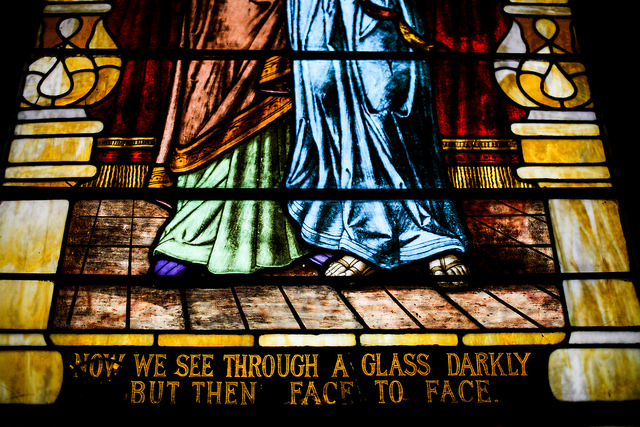
Seeing and Believing

Second Sunday of Easter, Year B

Almighty and everlasting God, who in the Paschal mystery established the new covenant of reconciliation: Grant that all who have been reborn into the fellowship of Christ’s Body may show forth in their lives what they profess by their faith; through Jesus Christ our Lord, who lives and reigns with you and the Holy Spirit, one God, for ever and ever. Amen.


John 20:19-31


When it was evening on that day, the first day of the week, and the doors of the house where the disciples had met were locked for fear of the Jews, Jesus came and stood among them and said, “Peace be with you.” After he said this, he showed them his hands and his side. Then the disciples rejoiced when they saw the Lord. Jesus said to them again, “Peace be with you. As the Father has sent me, so I send you.” When he had said this, he breathed on them and said to them, “Receive the Holy Spirit. If you forgive the sins of any, they are forgiven them; if you retain the sins of any, they are retained.”

But Thomas (who was called the Twin), one of the twelve, was not with them when Jesus came. So the other disciples told him, “We have seen the Lord.” But he said to them, “Unless I see the mark of the nails in his hands, and put my finger in the mark of the nails and my hand in his side, I will not believe.”

A week later his disciples were again in the house, and Thomas was with them. Although the doors were shut, Jesus came and stood among them and said, “Peace be with you.” Then he said to Thomas, “Put your finger here and see my hands. Reach out your hand and put it in my side. Do not doubt but believe.” Thomas answered him, “My Lord and my God!” Jesus said to him, “Have you believed because you have seen me? Blessed are those who have not seen and yet have come to believe.”

Now Jesus did many other signs in the presence of his disciples, which are not written in this book. But these are written so that you may come to believe that Jesus is the Messiah, the Son of God, and that through believing you may have life in his name.


Faith from the Margins to the Web Authors:  Steven and Harrison


Steven and Harrison are both men of great faith, who met each other the first time for this bible study.  Their conversation unfolded deeply and beautifully, even from this first meeting.

Steven began “What I really see the most out of this is the amount of disbelief, between both the disciples and the Jews, because he says the disciples had locked the doors in fear of the Jews, it says.  But Jesus comes and says, ‘Peace be with you’ and he meant that message for everyone…the disciples and the Jews…because he wanted peace.”

“I never really thought of that!” said Harrison, “the locked door, and the fear it represents.  That’s really neat. I’m struck by that word ‘peace,’ which is what Jesus says. It is the first word he greets people with after the resurrection.  The way you mention: fear, behind locked doors. Peace was probably the most important thing for them to feel and to believe.”

Steven and Harrison talked about the scripture…the way in which Jesus showed his hands and his side to help their belief.  But Thomas, not there during that first meeting, couldn’t quite fathom the belief that other disciples showed.

“Thomas wanted to verify it for himself” said Harrison.

“The other disciple tells him, ‘We have seen the Lord,’ but Thomas hadn’t seen for himself” noted Steven, thoughtfully. “But he said to them, unless I see the mark and feel the nails, I won’t believe.  That’s Thomas saying, ‘I need to have the experience you had so that I can believe!’ ”

“They probably did believe, before he died” said Harrison, “that didn’t fit into the idea of who the Messiah was.  But when they saw him, it was like their belief was resurrected. We hear Thomas doubting, but really, they all shared in that doubt.  It raises an interesting question to me: you know, you can think you believe something, but then when things don’t materialize the way that you expect them to, your belief crumbles apart.  Something doesn’t work out the way I expect God would have it turn out, and that shakes my belief.”

“Sometimes bad things happen for good, but it’s hard to hold onto that” said Steven.

Harrison replied, “But, when you do see God show up at the very end, faithful and true, even when the very bad things happen, then your faith is a little stronger.” 

When it came to discussing how this Gospel related to their own lives, Steven and Harrison both had poignant answers.

Steven described how it was for him:  “I have faith, even though I’m not really sure God is going to answer my prayers.  I think, God may have something in store for me. There are many times that my faith was shaken, that all the doors closed.  But then, God would lead me out, show me a circumstance, show me a way out that I couldn’t see before.”

Harrison related the most difficult time in his own life, when his son was tragically killed in a car accident.  “I had just finished watching a movie where the message was about someone who was sending his family a message that he was OK with dying.  Then, this phone call comes. And I thought, ‘God, how could you send me a message like that, but not stop the accident?” My life has been a lot of wrestling like that.”

“You know” said Steven, “I think our whole lives are going to be about questioning God.  I learned that you can question God, and talk with God, and still believe. Maybe sometimes God has to show Himself.”

“I wonder if Jesus came that second time, just to see Thomas, just to show himself because he knew that Thomas needed that in order to believe” said Harrison.  

Steven said, “You know, it reminds me.  Sometimes you have to look around and see your life, see the way God is working in your life.  If we don’t open our eyes to it, we can’t see. Then, when we open our eyes, we see how God is working.”

“I wonder, Steven, what does faith add to your life?” asked Harrison.

“Faith adds comfort, hope, resilience, and truth” said Steven, with thoughtful intention.

“For me, it’s that something wakes up in me because of faith” said Harrison.  “It means that whatever it costs it will be worth it to do the right thing, the loving thing, the honest thing.”
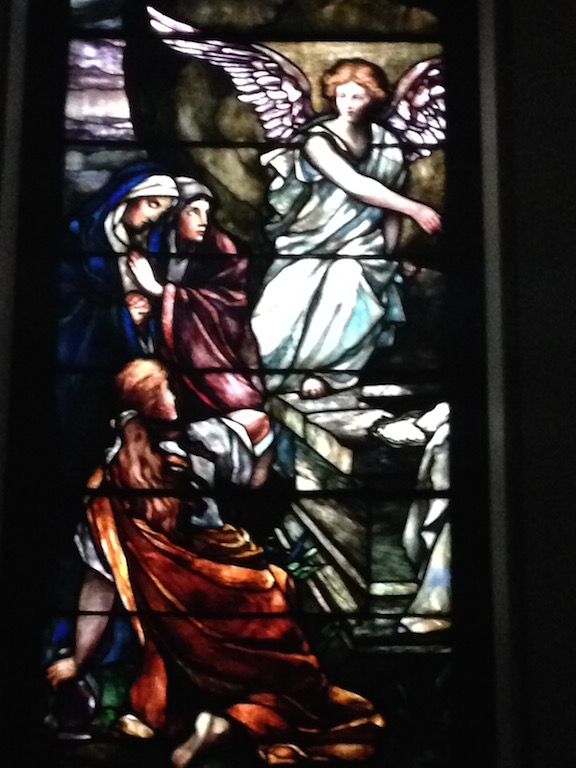
Resurrection

Easter, Year B

Almighty God, who through your only-begotten Son Jesus Christ overcame death and opened to us the gate of everlasting life: Grant that we, who celebrate with joy the day of the Lord’s resurrection, may be raised from the death of sin by your life-giving Spirit; through Jesus Christ our Lord, who lives and reigns with you and the Holy Spirit, one God, now and for ever. Amen.

John 20:1-18

Early on the first day of the week, while it was still dark, Mary Magdalene came to the tomb and saw that the stone had been removed from the tomb. So she ran and went to Simon Peter and the other disciple, the one whom Jesus loved, and said to them, “They have taken the Lord out of the tomb, and we do not know where they have laid him.” Then Peter and the other disciple set out and went toward the tomb. The two were running together, but the other disciple outran Peter and reached the tomb first. He bent down to look in and saw the linen wrappings lying there, but he did not go in. Then Simon Peter came, following him, and went into the tomb. He saw the linen wrappings lying there, and the cloth that had been on Jesus’ head, not lying with the linen wrappings but rolled up in a place by itself. Then the other disciple, who reached the tomb first, also went in, and he saw and believed; for as yet they did not understand the scripture, that he must rise from the dead. Then the disciples returned to their homes.

But Mary stood weeping outside the tomb. As she wept, she bent over to look into the tomb; and she saw two angels in white, sitting where the body of Jesus had been lying, one at the head and the other at the feet. They said to her, “Woman, why are you weeping?” She said to them, “They have taken away my Lord, and I do not know where they have laid him.” When she had said this, she turned around and saw Jesus standing there, but she did not know that it was Jesus. Jesus said to her, “Woman, why are you weeping? Whom are you looking for?” Supposing him to be the gardener, she said to him, “Sir, if you have carried him away, tell me where you have laid him, and I will take him away.” Jesus said to her, “Mary!” She turned and said to him in Hebrew, “Rabbouni!” (which means Teacher). Jesus said to her, “Do not hold on to me, because I have not yet ascended to the Father. But go to my brothers and say to them, ‘I am ascending to my Father and your Father, to my God and your God.’” Mary Magdalene went and announced to the disciples, “I have seen the Lord”; and she told them that he had said these things to her.

Listen as our Faith from the Margins to the Web Authors David and MaryAnn read the opening prayer together:

As soon as they finished reading the Gospel lesson, David immediately looked up and said, “Wow!  That’s powerful.  Mary understood immediately that Jesus had risen.  But it took other people time to figure out what was happening.  She knew, she must have. She says: ‘I have seen the Lord!’ ”

MaryAnn had noticed that, too.  “That is really interesting. Another thing that stood out to me when I heard you read it was all the people who were reacting in different ways.  That part about the two disciples running together, trying to get there first caught my attention. They are both running, and when the one disciple gets there he just begins to peek in.  But, Simon Peter goes barging right on in! Then, once Peter was in, the other disciple went in too. But they didn’t see Jesus…they just saw the empty tomb. And they went home and didn’t tell anybody.  But Jesus, He only appeared to Mary Magdalene, and she is the one who told people. She was there to mourn, she was weeping. And it was when she was weeping that Jesus appeared to her. He said her name, and that was when she knew it was him.  I thought it was interesting that the male disciples weren’t the ones to tell everyone. It was Mary who spread the word, who told people she had seen the Lord.”

“You know, I think they knew something had happened but the question was, WHAT had happened.  They didn’t know he’d been resurrected or…how did they say it back in the day…that he was the messiah.”  said David. “They were just like, ‘Wow, something has happened here…”

MaryAnn found this reassuring.  “The disciples lived with him every day, and they still didn’t understand,” she said.  So, if we don’t understand or we don’t know exactly what God wants us to do, we’re not alone…we’re actually in good company”  said Mary Ann. “Reading this has also given me a whole, new appreciation for Mary Magdalene and her recognizing and telling people what she had seen.  Jesus spoke to her, and she obviously wanted to touch him even though he wouldn’t allow her to do that.”

“Oh yeah, that’s the ‘hadn’t ascended yet’ part” said David. “I never knew what that meant before.”

“Right” said MaryAnn.  “And I mean, this was really something.  Women weren’t well regarded and yet, Jesus appeared to Mary Magdalene and told her to spread the word.”

David said,  “I think this reminds me that we need to know that God is there; that we have to believe it and not second guess it.  Then, that makes it real to us.”

Mary Ann acknowledged the resurrection has always been a mystery.  “What do you think it means in our lives, to be resurrected?”

David thought about this for a while.  “It’s pretty clear to me that being reborn is like when we’re baptized, when we are forgiven.  We get a new life, and we live differently, or we try to. I don’t have that…what do you call it…that community when I’m just with other people.  But with church, in God, we actually love each other in Christ. Seeing someone and saying,  “I love you, brother” you know, that doesn’t happen everywhere.  It sure doesn’t happen on the streets. Some evil happens there, that’s for sure.  But not always a lot of love. That’s a resurrection.”

Mary Ann thought about the question, too. “For me, retirement kind of feels like resurrection.  I used to work all the time. Now, I’m able to be reborn into myself; I can make decisions for myself instead of my job making decisions for me.  I feel like I’ve been able to live fully into who I am now.”

This was true in David’s life, too.  “There’s a lot of joy in me now. I mean, we don’t always have everything we need.  But in the church, people do help each other and help us do what we want to do. The Church is a place for resurrection, a place to get a second chance.”

As we celebrate the joy of this Easter season, where is resurrection in your own life?  


I wonder…

Palm Sunday, Year B

Almighty and everliving God, in your tender love for the human race you sent your Son our Savior Jesus Christ to take upon him our nature, and to suffer death upon the cross, giving us the example of his great humility: Mercifully grant that we may walk in the way of his suffering, and also share in his resurrection; through Jesus Christ our Lord, who lives and reigns with you and the Holy Spirit, one God, for ever and ever. Amen.

Mark 11:1-11

When they were approaching Jerusalem, at Bethphage and Bethany, near the Mount of Olives, Jesus sent two of his disciples and said to them, “Go into the village ahead of you, and immediately as you enter it, you will find tied there a colt that has never been ridden; untie it and bring it. If anyone says to you, ‘Why are you doing this?’ just say this, ‘The Lord needs it and will send it back here immediately.’” They went away and found a colt tied near a door, outside in the street. As they were untying it, some of the bystanders said to them, “What are you doing, untying the colt?” They told them what Jesus had said; and they allowed them to take it. Then they brought the colt to Jesus and threw their cloaks on it; and he sat on it. Many people spread their cloaks on the road, and others spread leafy branches that they had cut in the fields. Then those who went ahead and those who followed were shouting,

“Hosanna!
Blessed is the one who comes in the name of the Lord!
Blessed is the coming kingdom of our ancestor David!
Hosanna in the highest heaven!”

Then he entered Jerusalem and went into the temple; and when he had looked around at everything, as it was already late, he went out to Bethany with the twelve.


Faith from the Margins to the Web Contributors: MaryAnn and Kayu

Conversation came easily to MaryAnn and Kayu, even though they had never met until that afternoon of our Faith from the Margins bible study.  They had chatted together and solved many of the problems of the world before the tape recorder was even turned on.  But after they began taking turns reading this Palm Sunday narrative began to hone in on this idea of “obedience” as it emerged in the Gospel lesson.

Kayu shared what stood out to him. “I have to come back to that word, obedience. It wasn’t easy to be obedient. It look a lot. Coming from Japan, for the first 18 months I was fighting every day because its what I had to do. But once I started becoming obedient, I learned not to fight back. They had seen me fight, but there comes a point in time when you have to let it go; when you have to let that control go to God. Where would it have gotten me in life to stubbornly keep that control? It would have made me a not very nice person. A fighter, street person, always in jail: anything could have happened. Then, at some point, when I stopped fighting that’s when people got curious.”

“So it really took a different kind of strength to stand than it did to fight.” said MaryAnn

Kayu agreed: “Yes, spiritual strength.”

“I’m not a physical fighter” said MaryAnn, “but I fight a lot with the way mentally I want things to be. I can wish that life was different, or that someone else hadn’t done something. I can fight verbally sometimes and that same lesson applies: we can choose to just stand.”

“I had a good teacher!” noted Kayu.

MaryAnn chuckled.  “I was just going to ask how you learned that!”

Kayu share his story. “It was my Grand-father. He was a musician, and the first African-American allowed to walk into the white house to play a private concert. It was for Theodore Roosevelt. He was inducted into the Hall of Fame and he was a great man, but his words were always, “No matter how big or how small, you need to make a mark in life. If you can touch one, it makes up for the thousand. I decided that was what I wanted to do. I started fighting for homeless people in 1992. I asked God: what can I do? What kind of mark can I make on this earth? And that is what God told me.”

Mary Ann was genuinely curious: “But, how did you do that? I mean, what was it like to hear God?”

“Well, it was easier than you think.” said Kayu.  “I was praying…I had just come home from the war. And one day, I went walking and I was just struck by seeing so many homeless people in parks, on the streets. I thought, “This is not what I fought for; this is not what I should be coming home to.” I realized that I had to do something about this; I didn’t almost die for a country where people were homeless and dying and other people could look at the window and see it and not do anything. I’m a Marine…we are supposed to do things that help make a path for change. And to do that and come here and think: what are we doing? Why are we, in this country, having people who are homeless and who have skills and degrees. I said to God, “I’m a nobody, what can I do?” and God said, “Just do.” I had to obey and as I did, the ways I could make changes become clear to me. It is about knowing your calling, and also being willing to do it. There are both in today’s story. People need to hear: don’t try to do it on your own. Listen to God. God will tell you what you need to do.”

MaryAnn built on this, “Wonderful answers come through prayer. If I’m praying consistently about something, it isn’t that the situation changes but I change.”

“And that DOES change the situation” said Kayu.

MaryAnn echoed that: “Right, exactly! That is the way that God can be working, changing us which makes us and the situation change.”

The final sharing about this Gospel came through an exercise in which they were asked to share “I wonder” sentences about the reading from perspective of any of the characters in this Gospel lesson.  MayAnn and Kayu both entered deeply into this exercise and took turns in a free flow exchange of questions and thoughts:

“I wonder if Jesus knew that the disciples would obey him?”

“I wonder what the people who were watching were thinking?”

“I wonder what the disciples thought Jesus was going to do with the colt.”

“I wonder why the people who say this guy coming in on a colt decided to shout Hosanna?:

“I wonder why they decided to lay down the palm leaves when they really didn’t know who he was?”

“And, I wonder if the Colt thought, “Why does this man want me? Is it because no one has ever ridden on me? Is it because I’m pure of heart?”

“I wonder what the rest of the Colt’s life was like? After that day, all those palm branches and all of those crowds…what happened after that?”

“I wonder how Jesus knew just where the colt was?”

“I wonder why they allowed the disciples to take the colt?”

“I wonder if they actually knew who Jesus was?”

“I wonder if people had the sense that there was something different about this event, this day, this person.”

Kayu became reflective as they shared this exercise of wondering.  “You know, when I did this, I put myself right back there. What would I have done, if I really didn’t know Jesus as Lord, but the man Jesus came up to me and asked me to do this. I wonder if I would have been so obedient?”

Mary Ann nodded, “Yes, I wonder: what made them obedient?  What compelled them to listen?

“Faith like a mustard seed.” said Kayu. “God moves our hearts, but we have to move our feet and follow.”


Thank you, Kayu and Mary Ann, for sharing your stories and your wonder with us.  I wonder, after reading this reflection, where God is moving our heart to see new opportunities to serve, and moving our feet to follow?


So Much Love

Fourth Sunday in Lent, Year B 

Gracious Father, whose blessed Son Jesus Christ came down from heaven to be the true bread which gives life to the world: Evermore give us this bread, that he may live in us, and we in him; who lives and reigns with you and the Holy Spirit, one God, now and for ever. Amen.

John 3:14-21


Jesus said, “Just as Moses lifted up the serpent in the wilderness, so must the Son of Man be lifted up, that whoever believes in him may have eternal life.


“For God so loved the world that he gave his only Son, so that everyone who believes in him may not perish but may have eternal life.


“Indeed, God did not send the Son into the world to condemn the world, but in order that the world might be saved through him. Those who believe in him are not condemned; but those who do not believe are condemned already, because they have not believed in the name of the only Son of God. And this is the judgment, that the light has come into the world, and people loved darkness rather than light because their deeds were evil. For all who do evil hate the light and do not come to the light, so that their deeds may not be exposed. But those who do what is true come to the light, so that it may be clearly seen that their deeds have been done in God.”


Faith from the Margins to the Web Contributors:  Alisha and Lynette

In these recent days and weeks, I’ve heard more than a few (good, kind, caring) people say that they fail to understand how God could love this world. We are human beings who get lost sometimes, wandering in the darkness of violence, death, and destruction where we can’t quite find our own way out.  We can feel helpless and even hopeless. But, here in the midst of our Lenten wilderness, we are reminded of a deep and resonant truth: God loves us. God profoundly loves all of us, and the collective “us” that we can even have trouble loving ourselves.  Let me say that again: God loves each of us as individuals, but God also loves US, the world, even when we are fed up and even with all the times we fall and are drawn in to the structures and power of evil. God loved the world so much, that God’s very self entered into this world to experience life with us.  It’s probably the first bible verse you memorized as a child.  Maybe it’s the one we most need to hear…really hear…as adults.

This week, two of God’s beloved children, Alisha and Lynette, share for us something about this message of lavish, divine love:

Lynette, a regular visitor at feeding programs throughout the city, began the conversation by reading the Gospel lesson.

Alisha, a student just getting ready to embark on a spring break mission trip, chose to spend the afternoon with our Faith from the Margins bible study.  She began by asking Lynette what stood out to her. Lynette said was familiar with the verse, but what stood out to her right now was amount of evil she had been feeling in the world. “These killings, and these kids. It’s just too much to hear about, too much evil every time I turn on the news.”

Alisha nodded, realizing that Lynette spoke for the way so many of us feel rocked by the nature of violence.

Lynette went on to tell the story of someone she knew who was killed, leaving behind young children. “I’m sorry that I feel like I don’t have much to say these days. It seems like the world isn’t going to last long.”  The sadness hung on Lynette’s voice of age and experience.

Alisha paused and seemed to reach into a place in her heart where God was speaking.  “I hear you” she said, “but what stood out to me is love, ‘For God so loved the world that He sent His only Son.’ Those words are about so much love. Not everyone believes that, not everyone believes in Jesus or God. But God doesn’t just love the people who believe or who read the scriptures or who go to church or who know how to pray. God loves the world, the whole world. Jesus came for everybody, no matter what. I think people don’t see how great that is, how amazing it is to be loved that much. He didn’t make the world a bad place, or to hurt people or set them against each other. He did it because of love.”

Alisha continued, as Lynette listened thoughtfully.  “You were talking about the darkness of the world, Lynette, and I think that it does say in here that people are drawn to the darkness. God knows people will still choose darkness, but Jesus, in a way, is the Light because God knows there will be darkness. So no matter how dark the world seems, the Light of Christ cannot be taken away. His light will continue to shine no matter what. I think that’s a hope to hang onto, especially when we see so many shootings and so many problems going on. The President, the United States acting like we don’t know how to run a country, and then our regular struggles of everyday life on top of that. It’s a lot. And Jesus the Light is still here.”

Lynette smiled a little, feeling some of that light.  Finally, she said, “You know, I see God everywhere I go. You know, when you have good days, you think, “God is on my side.’ If you are happy, having a good day, you see God everywhere. Then if anything happens, you have to remember that God is still on your side.”

Alisha said, “Right now, I’m trying to seek God more. I’m realizing that God is putting people in my life to help remind me, to know God is there. Like you said, on good days its easy to feel that God is there. But then there are other days when you think, ‘why does this stuff keeping happening? Where is God in this?” and its usually through those other people, the people who help me see God again.”

“Do you believe in God?” Lynette asked.

“I do, I really do!” said Alisha.

“That’s good” said Lynette, “Not a lot of people do. But I do, too. I go to bed at night and I pray. I say that God wakes me up in the morning and when there is a new day, I am grateful for that, and I pray again.”

“There’s something about praying by yourself” said Alisha. “It’s like it’s just you and God, and you feel like you can be more open. It’s like I get my faith and reassurance about who I put my trust in most. It isn’t just the words, its the meaning in my heart. I try to see God.”

“He’s around!” said Lynette.

They both laughed.

“People need to read this scripture” said Lynette, “they need to be reminded of what is going on, not just to get stuck in the darkness.”

“It’s nice for us to read it,” said Alisha, “but we’re also supposed to live it and spread it, too. I think just sharing a word sometimes…especially the love, that fact that God loves us no matter what, no matter if we don’t even believe it or don’t even believe in God…that message is something we need to share.”

“Do you have family around here?” asked Alisha. They started to talk about their families, the sisters and brothers and for Lynette, her children.

“Did you grow up in the Church?” asked Alisha.

“Yes, well, almost every Sunday my Momma made sure that we were in Church.” answered Lynette. “How about you?”

“It was the same for me” answered Alisha.  “Now, I try to go to church every Sunday.”  This was a commonality they both valued; the way in which attending to God had been made a priority in their lives, even when there was a lot of other things and many other challenges happening.

Alisha and Sheryl each shared a time when they knew unconditionally that they were loved by God.

Lynette shared about her good days. “Things are going my way, and I think, I’m loved by God. I know it doesn’t sound exciting, but when I go to the doctor, I get out, I realize God is good and I feel really loved by God.”

“For me,” said Alisha, “there was a time when I was really lonely. I mean, I had friends and people around but there wasn’t really anyone that I could talk to, that I could connect with deeply. And then I went to church one Sunday and they were singing this gospel song, it was “Halleluia, you have won the victory, death cannot hold you down, you are the risen King…” I remember that vividly.  It was a just a time, a moment for me when I realized it wasn’t even about me feeling good all the time. If I felt lonely, or if I felt down that God was still with me. God loved me for me. So, remember that God loves you, no matter what has happened to you, good day and bad days.”

May these grace-filled words from Alisha and Lynette fill you with love, this day and in the days to come…


Losing It

Third Sunday in Lent, Year B

Almighty God, you know that we have no power in ourselves to help ourselves: Keep us both outwardly in our bodies and inwardly in our souls, that we may be defended from all adversities which may happen to the body, and from all evil thoughts which may assault and hurt the soul; through Jesus Christ our Lord, who lives and reigns with you and the Holy Spirit, one God, for ever and ever. Amen.


John 2:13-22

The Passover of the Jews was near, and Jesus went up to Jerusalem. In the temple he found people selling cattle, sheep, and doves, and the money changers seated at their tables. Making a whip of cords, he drove all of them out of the temple, both the sheep and the cattle. He also poured out the coins of the money changers and overturned their tables. He told those who were selling the doves, “Take these things out of here! Stop making my Father’s house a marketplace!” His disciples remembered that it was written, “Zeal for your house will consume me.” The Jews then said to him, “What sign can you show us for doing this?” Jesus answered them, “Destroy this temple, and in three days I will raise it up.” The Jews then said, “This temple has been under construction for forty-six years, and will you raise it up in three days?” But he was speaking of the temple of his body. After he was raised from the dead, his disciples remembered that he had said this; and they believed the scripture and the word that Jesus had spoken.


Faith from the Margins to the Web Authors: Tom and Sandy

Tom, a regular attendee at weekly parish feeding ministries and Sandy, a new Faith from the Margins participant invited by her VCU student daughter both bring lives of prayerful insight into this week’s Gospel lesson.  After they prayed together and read the Gospel lesson, Tom opened their conversation thoughtfully:

“I was just thinking, this is an amazingly straightforward passage. Especially for John, because he’s so esoteric, kind of a dreamer. But, this is clear like he was there. It’s a good one, because they didn’t really realize at the time that Jesus was talking about his body, his own temple, when he talked about destroying and rebuilding. Maybe John was taken in by all that foreshadowing!

Sandy found another part of the passage speaking to her.  “The thing about this that I love is that people think Jesus is all nice and sweet and calm and all of that. But here, there is a righteous anger, and I really love that fact, that he threw the tables over and even made himself a whip. It helps me when I’m talking to my son about his anger, because it makes it real and relatable. Feelings are feelings, they just are. They aren’t good or bad. Your actions might be good or bad in responses but your feelings are your feelings. And knowing that Jesus had feelings, just as we do…that’s important!”

Tom related to that as well:  “Oh yeah. Both fully God and fully human. If you’re fully man there are feelings you have to deal with. If you’re fully God, you can tap into that part. But, there are always going to be feelings that we can relate to. I’m kind of laughing because sometimes when people say, ‘What would Jesus do?’ the honest answer might be making a whip and kicking you out of this building! And righteously so!! We can forget this part of the story. But think of it from Jesus’ viewpoint:  there was so much corruption. Whenever there is power, people get corrupted. Here, in this Gospel, it was for making a few extra shekels from the money-changers. But there was a real problem…it got bigger, suddenly like Vegas or something. Even the poorest of people could come to the temple and worship, but then they were being taken advantage of while the rich were flaunting their wealth.”

The two were finding their thoughts coming together as they imagined this image of Jesus responding to injustice.

Sandy spoke next, “Well, that’s just it. I love that he got angry, that there were things that he had to deal with. He wasn’t just sitting back and letting things happen.  He spoke his mind.”   She paused and chuckled a little, a memory coming into focus from her own life: “It reminds of one time, when we had some fundraising thing at school when I was little and I brought my sales form to church and pulled it out Sunday morning and started asking people to buy things. My mother snatched that out of my hands; she was furious! “This isn’t the place for that!” she said. I didn’t really understand it all at the time, but, it was clear to me that I had crossed a line!  But now, I start to see. Church has to be different; we’re here for a different reason.  Sometimes you need to point out the reason and then people begin to see things differently.”

Tom nodded.  “I mean, I know that there are times when churches need to have fund-raisers or they are doing something over and beyond to help others. Any church can have good intentions, but they can also fall into it being all about the money. People are well meaning, but it can easily happen. This story reminds me of that; the money changers and those selling animals for offerings weren’t there with a bad intention originally…people travelled for miles and it made it possible to come and make a sacrifice, no matter how much money one had or didn’t have.  But it slipped away from them about why it was supposed to happen.  It started to become about ways in which people could make money, skim a little off the top, and take advantage. It’s like a wake-up call to pay attention!”

Tom and Sandy exchanged some stories of greed and corruption that they have seen emerge in the church, even recently. Tom related a story of Pope Francis calling out a Bishop building an extravagant residence in order to convert it to homeless shelters. “It seems like he is trying to set a good example, but you see these glaring examples when they come up how easily people can be caught up in greed instead of charity.”

Sandy nodded. “I support a couple kids in the Dominican Republic, and I have for many years.  It isn’t a hands-off kind of thing; I’ve been on trips to help build churches and hold Sunday School for the kids and make relationships that last. That last story you told reminded me of how much we have to check our intentions.  When we go, there is a “free day” and I known I could go anywhere.  Sometimes we are encouraged to take a break, and there’s nothing wrong with that.  But I find that I just want to be with the kids, to see things from their eyes.  It changes me, and makes me think differently about how I invest my time, and my money.  When I was over there, I was shocked by the fact that there were two types of people there: the incredibly rich, and the destitute poor. It struck me, that stark difference. I used to get my nails done, I wore an expensive ring my husband gave me.  After I visited I though, ‘Yes, it’s beautiful, but is it necessary?’ I came home, and I was changed. I started to wonder, ‘how can I justifying spending money every week for something as trivial as fingernails!’ It made me aware of what more I could do for people than wasteful things. We just have so much waste, but we could have so much to give.

Tom summarized up their reflections, “Well, this passage reminds us what really does count, not just what doesn’t. If it comes to matters of faith and knowing God, stick to that. Don’t get caught up in people’s ideas of how to get ahead. The world has one way of doing things, but God has another plan.  It also reminds me that sometimes, it’s OK to lose it! Sometimes we have to act.”

This image of Jesus’ anger can be shocking and put us off.  But, both Tom and Sandy were able to find in it essential qualities of our own human lives, as well as the immanent hopefulness of change.  How many times do we need to be jarred into seeing something for what it has become, instead of just going along with the status quo?  How often might something that starts out as a good intention drift off to serve selfish needs?  We might need this image of Jesus to startle us, to take a deeper look at what motivates the actions of our daily lives.  We are given the gift of transformative potential, in the form of God made human.  God is not the destroyer; God is the re-builder and re-maker of our lives, of this world in which we live.  Thank you to Sandy and to Tom for sharing the Good News of this transformation potential of awareness with us this week.

Divine Things

Second Sunday in Lent, Year B

O God, whose glory it is always to have mercy: Be gracious to all who have gone astray from your ways, and bring them again with penitent hearts and steadfast faith to embrace and hold fast the unchangeable truth of your Word, Jesus Christ your Son; who with you and the Holy Spirit lives and reigns, one God, for ever and ever. Amen.

Mark 8:31-38


Jesus began to teach his disciples that the Son of Man must undergo great suffering, and be rejected by the elders, the chief priests, and the scribes, and be killed, and after three days rise again. He said all this quite openly. And Peter took him aside and began to rebuke him. But turning and looking at his disciples, he rebuked Peter and said, “Get behind me, Satan! For you are setting your mind not on divine things but on human things.”


He called the crowd with his disciples, and said to them, “If any want to become my followers, let them deny themselves and take up their cross and follow me. For those who want to save their life will lose it, and those who lose their life for my sake, and for the sake of the gospel, will save it. For what will it profit them to gain the whole world and forfeit their life? Indeed, what can they give in return for their life? Those who are ashamed of me and of my words in this adulterous and sinful generation, of them the Son of Man will also be ashamed when he comes in the glory of his Father with the holy angels.”


Faith from the Margins to the Web Co-Authors:  Lisa and Raven


This slideshow requires JavaScript.


Lisa and Raven are both first year college students, even though they are several decades apart from each other in age.  The joy between them was palpable, as was their commitment to the lives of faith that has accompanied them on the twists and turns of life’s journey.  They read the scripture out loud, together, before turning to the bible study questions.  Listening them reminded me that it isn’t our age or race or social position in life that matters: it is the focus on the truly divine.  In Lisa and Raven, we can hear more about finding God in the midst of what seems like the world turned upside down.  As they both point out, it’s all a matter of perspective: our own, or God’s.

Lisa opened with the bible study question of what stood out the most to each of them.  Raven responded, “For me what stands out is ‘get thee behind me Satan’ because it seems like he’s trying to assert his presence in that place, and Jesus just won’t allow it.  It’s like no matter how much Satan wants to get the upper hand, it isn’t going to happen.”

Lisa agreed, “I think that’s true because, well you know, Satan tries to get us to do the wrong thing all the time, which is why he needs to get behind me! [they both chuckled].  To me, the whole thing has a great meaning, but the line that just stands out the most is the one about setting your mind on divine things, telling the rest to move behind.”

Raven thought some more, “I would say also that “those who will lose their lives for my sake” seems to stand out to me, not just here, but in the whole Bible. The world can seem so topsy-turvey when we’re only looking at our human perspective on things but then God…Jesus…seems to be flipping everything around, but really they are not flipped at all.  Jesus is resetting it like it should be.”

“Yes,” agreed Lisa, “and to us, it seems like the world is being flipped upside down because we have a way we think that we should be, and when it doesn’t happen that way we get upset and turned around. We think, “Oh my gosh, things aren’t going right!” But things actually ARE going right, they are going in a way that may make sense to God even if they feel up in the air to us. I think: ‘this is messed up, I’m disombobulated’…but that’s my own thinking!

Raven reflected on this, “Yeah, I was just talking about that with the kids in my youth group last night. Just because there is a way that you think it is supposed to happen, that doesn’t always mean that is how it should happen. God will give what has been promised, but it may not look exactly like you think it would.  That’s a hard lesson for us.

“Right,” said Lisa, “we just don’t realize it at the time!”

Lisa continued: “Maybe you thought your goal was one thing, but they you start walking the path and other things open up in ways you couldn’t have imagined. And you realize, the path that you’re walking is the right one even if it wasn’t the one you thought it would be. It’s just amazing how that works. One minute you’re over here, and the next minute you’re over there. And you wonder…how did this happen? And then, I’ll sit and think about it later and I realize that it’s gotten me to a place where I needed to be all along. It’s like now, and the process that has led for me to be back in school. It felt like it took so long, but I learned about perseverance that I never knew I had. I needed the lessons I’ve learned and now I’m in it, I’m ready, and it’s going really well!”

This resonated with Raven: “It just makes me think, how many times has a door closed and I’ve been so upset. And then, things work out in a way you’d never expect. I was so sure about wanting to go to school somewhere else; I was sure I wanted to be in Princeton or at UVA. But then, things just kept happening. The doors just weren’t opening. I didn’t get good financial aid, I thought about taking loans. And then I looked again at VCU and I got great support, it was closer to home, and it was a decision that God allowed me to see as an opportunity. And now, I cannot imagine myself happier at any school. This is exactly where I need to be, even though I didn’t know that at first.”

“It’s my first year at school, too” said Lisa, who is now in a human services program at Reynolds Community College. “I’m working to be a substance abuse counselor and once I finish my Associate’s Degree, one of the places that I can transfer when I finish is VCU!” she added. “It’s something to think about, and it’s new to me. I’m starting out slow and I have choices which is something I didn’t even think I had before.”

Raven said, “It makes all the difference to have choices!”

The two began to discuss where they could see God in this Gospel lesson. Lisa began: “Well, right now I’m going through a lot with my family. I just lost my mother on New Year’s Day. She had a stroke, and it was really hard for her. I miss her, but I know that she would be proud of me. I feel that.  I see God in those places, where we are taking up our cross.”

Raven said, “I remember when my Grandmother passed away, and I was only 14. She had Alzheimer’s but it happened quicker than we thought. It’s so hard, and it’s always a grief for us. I think for me, I also see God in this Gospel right now in the part where it says, “Take up your cross and follow me” but in another way. I have a very headstrong family: they see something, they believe in something, and they are just going to go for it. But, you know, this scripture reminds us that our goals have to line up with God’s goals. I have to pause and look at all the things I’m doing and ask and pray, “is this what God has in mind for me?”

Lisa said, “Yeah, a lot of people have this question of whether something is my way, or God’s way. But, I think we need the time to actually see and feel God in our lives. I like how you talk about having those goals, though, because some people seem too quick to give up.  It’s about your goals but bringing them to God.”

Raven shared next, “This year, my biggest challenge is the verse I’ve picked for myself: Be Still. I’m always busy, always on the run. But, I have to remember that “be still” because it isn’t just physical stillness, but mental stillness. I need to be sure that my mind is still, that I can hear and listen.”

Raven and Lisa closed by sharing about what it means to set your mind on divine things.

Raven began the sharing, “I think for me, I used to think it was more like: ‘don’t think about bad things, only think about good things’ but that isn’t really it. Now I think of it as searching for the Godly, even in the bad things. Remembering that in the midst of that, to reorient my focus to the fact that even when there is something bad going on, there is something greater still and that is where God is.”

“Right,” said Lisa, “there are a lot of people who ask, ‘Why do bad things have to happen to me?’ But bad things happen to all of us sometimes. If we got everything we wanted, every day of our lives then we really wouldn’t appreciate anything. We get stuck in ‘why me?’ but then, down the road, I realize that in every bad thing that has happened, there has been something good to have come from that.”

Raven said, “God never promises a trouble-free life; the difference is that even in the midst of our troubles in life when we think on divine things, we are never alone.”

“Like He says” quoted Lisa, “I will never forsake you.”

Raven and Lisa continued to talk together about their studies and the lessons that had unfolded for each of them.  God never does love us, or forsake us.  Sometimes, God comes in the form of people who once were strangers, who once seemed so different.  But really, when God is with us we have far more that unites us than could ever divide us.


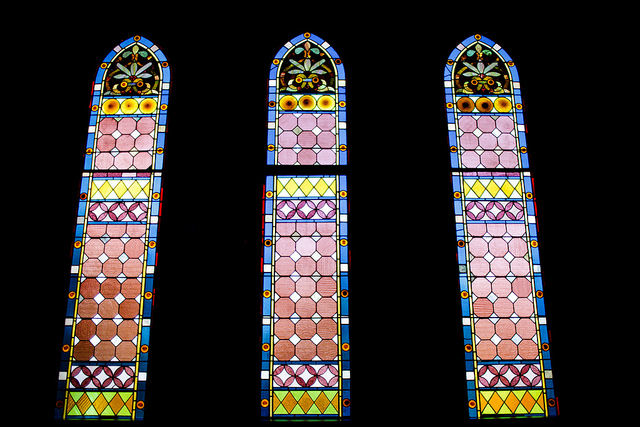
three windows

On the mountain or on the street

Epiphany 6, Year B February 11, 2018

Last Sunday after the Epiphany

O God, who before the passion of your only-begotten Son revealed his glory upon the holy mountain: Grant to us that we, beholding by faith the light of his countenance, may be strengthened to bear our cross, and be changed into his likeness from glory to glory; through Jesus Christ our Lord, who lives and reigns with you and the Holy Spirit, one God, for ever and ever. Amen.

Mark 9:2-9

Jesus took with him Peter and James and John, and led them up a high mountain apart, by themselves. And he was transfigured before them, and his clothes became dazzling white, such as no one on earth could bleach them. And there appeared to them Elijah with Moses, who were talking with Jesus. Then Peter said to Jesus, “Rabbi, it is good for us to be here; let us make three dwellings, one for you, one for Moses, and one for Elijah.” He did not know what to say, for they were terrified. Then a cloud overshadowed them, and from the cloud there came a voice, “This is my Son, the Beloved; listen to him!” Suddenly when they looked around, they saw no one with them any more, but only Jesus.

As they were coming down the mountain, he ordered them to tell no one about what they had seen, until after the Son of Man had risen from the dead.

Faith from the Margins to the Web co-authors:  Steven and Mary Ann


After he finished reading the Gospel lesson, Steven noticed something: “The last part here, it really took me by surprise:  As they were coming down the mountain he ordered them to tell no one.  To me, that’s pretty heavy.”

Mary Ann was surprised, too. “After they had seen something like this, you would think they would want to talk about it, to tell everyone, not to stay quiet about it!”

Steven was putting himself in the perspective of those disciples, searching for answers: “I know, I know…what is the time period? Jesus hadn’t even died yet.  Did they even know about the resurrection?  How long did they think were they supposed to be quiet?!”

Mary Ann and Steven walked through the timeline of the Gospel story together and realized this event, the Transfiguration, was all happening at a time when his disciples really weren’t even “getting it” that Jesus was going to die, let along being raised to life again.

“I guess he was saying to them wait, to wait until he had been risen.” said Mary Ann.
“But you know, it is interesting because he specifically took these three disciples with him: Peter, James, and John.  I guess that is because he really trusted them, and he didn’t want to do this alone.  He wanted his friends to be with him.”

Steven narrated, “So, then they went by themselves, no one else. And then they saw him transfigured.”

“You know, when you were reading…” said Mary Ann “….when you read that part that they were white like no one on earth could bleach them, I immediately thought of my mother. She was a firm believer in Clorox! She would bleach things to an inch of their lives, but I guess this was even whiter than that. So then, after all those dazzling clothes, Moses and Elijah appear…long dead, and yet there they are.”

This seemed to put the story into a new perspective for Steven: “Yes, and that’s when Peter said to Jesus,  ‘It is good for us to be here…’ because Peter wanted to make three dwellings. Wait, did those dwellings ever get made?”

Mary Ann answered, “I don’t think so…I think maybe Peter wanted them made, like he wanted a house or something, some place to stay.”

Steven nodded, relating to that feeling, and continued: “they didn’t know what to say, for they were terrified.” Yeah, I’d be terrified, too!”

The story began to come together as it may have felt for us in our everyday lives.  Mary Ann pondered a bit:  “I’ve never seen a vision, so this is so interesting to me, imagining what it must have really been like for them, which I think is what Mark is trying to convey. Have you ever seen a vision?”

Steven responded a bit shyly, “Um…Yes. My mother. She appeared to me one morning, and then she disappeared.”

“Wow! Were you terrified?!” asked Mary Ann.

Steven continued, “Yes, well, honestly Yes, I was! I was in the kitchen, I put on a pot of coffee. And she was there, right there, and then she disappeared.”

“Was this not long after she had passed?” Mary Ann wondered.   “I bet you might have wanted to build a dwelling so she would stay too.”

Steven nodded, remembering, “Yeah, that’s right. It was about 8 or 9 months after she had passed. I was shocked that whole day. I told my sister about it right away. I didn’t have time to say anything, and I didn’t really know what to even say, but I had to tell someone, you know. So, that all makes me think…that’s why I think that even though Jesus ordered them, how is it that they could have not told anyone?”

Mary Ann was thinking about this, too.  “Sometimes, there have been times that I felt the presence of people my mom, my dad, my sister…but I didn’t see them.”

“It tells me, it reminds me that our spirits live on.” said Steven.

A light bulb went off for Mary Ann.  “You know, that makes me wonder: what if Mark was trying to convey that it was that the spirits of Moses and Elijah who were there, living with Jesus? I guess part of the message here may be that their spirits…the spirits of these two great prophets lived with Jesus, and Jesus lived with their spirits.”  she paused. “Huh.  That’s really interesting.  I mean, I never really thought of that.”

Steven went back to read the prayer again:

Grant to us that we, beholding by faith the light of his countenance, may be strengthened to bear our cross…

Mary Ann was having another epiphany. “I’m reading that again all new now. That’s a powerful message. We all have crosses to bear, don’t we. For me, one of my crosses is loneliness.”

Steven appreciated this, and it resonated with him.  “Yeah, that can be painful. Loneliness can be very painful. It can feel like you don’t have no friends.  Loneliness, depression: these are our crosses.”

“I go back to that prayer, too.” said Mary Ann:  that we may be changed into his likeness from glory to glory.   So, like Jesus was transformed, we can be strengthened and changed too.”

“That word,” said Steven: “His countenance.”

“And countenance usually refers to face” added Mary Ann, “so reading it that way: we, beholding the light of his face, can be strengthened to bear our cross. It’s as if looking at the light of Jesus, seeing His face, makes us strong enough to bear our own crosses.

“Right!” Steven responded. “Loneliness, depression, fear, uncertainty…these are the things we have to look to him for, to pray about.”

Mary Ann added, “what I’ve noticed is that I have faith that my prayers reach God, but what I’ve noticed is that my prayers change me. When I pray about my fears, it helps me. Maybe that is God working, making me feel stronger.  What do you pray for?”

Steven answered thoughtfully, “I pray for my family, my friends, my brother and sister. I pray for the homeless, because I was homeless once. I don’t pray to be rich, but I do ask God to give me enough, to provide what I need. I pray to get through month to month but I don’t pray for all those riches. I have enough.   Yeah, I pray for the homeless all the time. I was homeless for almost a year and half. When I moved here, I was on a waiting list for housing but it took like a year and a half. It was so, so hard. It takes so, so long.”

Mary Ann responded with empathy, “I can’t know what that’s like but it seems like we could do better. I’ve heard from a lot of people that they did everything that was asked of them, but it still takes forever.”

Steven felt affirmed, “Yes, it does. I was just about ready to give up. I thought, if nothing changes soon I’m going back to Roanoke to live with my brother and sister. Then, I saw my case worker again one day when I was just ready to give up and she said, ‘Guess what? An apartment came through!’ and I was moved in later that week.”

“Well, good for you for sticking with it!” said Mary Ann.  She was still floored by imagining spending that much time homeless. “What did you do? Did you stay in a shelter?”

“Well, I did sometimes.” answered Stephen, “But I did a whole lot of sleeping on the street.”

“Wow. That’s got to be scary.” said Mary Ann.

“It is, ” Steven reflected. But then he told a hard truth, “but some of the shelters, they are so overrun and so overcrowded.  People don’t bathe, people want to fight, and I am a quiet and gentle person so that was hard for me.”

The picture was becoming clearer for Mary Ann, “Wow, so the street seemed safer…”

Steven confirmed it, “the street WAS safer for me than the shelters.”

Mary Ann asked, “Did you have a community? You know, that would look after each other?”

“Yeah, I developed friends.” said Steven. “We’d get together and find a place.  It’s safer sticking together than sleeping alone on the street. They are still my friends. A lot of homeless people go it alone, though.”

“I really admire you.” acknowledged Mary Ann. “I mean, I just don’t know if I could do it, if I could survive…”

“It’s a rough life” admitted Steven,  “It’s a very rough life.  But, this Gospel reminds me that God was always with me.  God is always with us.  Peter and those up on that mountain, they knew that.  I bet they wanted to try to tell people what that was like.”  He was thoughtful for a moment, then added, “But even if it’s hard, like when Jesus ordered them not to say anything, we have to try to follow his word.”

This week, after listening to Steven and Mary Ann reflect on this Gospel, I am reminded that the light of Christ, the face of Christ that we see in the eyes of our heart, is present with us whether we are at the height of the mountaintop or the roughness of the street.  It’s why I’ve come to know through these conversations and interviews that the prophets of the street corner have so much to teach us, so much to convey about the ways in which God is present even in the places where it is hard for us to imagine God being.  But, there is no height or depth, no dark corner or noisy shelter that is hidden from the Light of Christ.

25099458708_ed563be2e4_z


Healing Welcome

Epiphany 5, Year B

Set us free, O God, from the bondage of our sins, and give us the liberty of that abundant life which you have made known to us in your Son our Savior Jesus Christ; who lives and reigns with you, in the unity of the Holy Spirit, one God, now and for ever. Amen.

Mark 1:29-39


After Jesus and his disciples left the synagogue, they entered the house of Simon and Andrew, with James and John. Now Simon’s mother-in-law was in bed with a fever, and they told him about her at once. He came and took her by the hand and lifted her up. Then the fever left her, and she began to serve them.


That evening, at sundown, they brought to him all who were sick or possessed with demons. And the whole city was gathered around the door. And he cured many who were sick with various diseases, and cast out many demons; and he would not permit the demons to speak, because they knew him. In the morning, while it was still very dark, he got up and went out to a deserted place, and there he prayed. And Simon and his companions hunted for him. When they found him, they said to him, “Everyone is searching for you.” He answered, “Let us go on to the neighboring towns, so that I may proclaim the message there also; for that is what I came out to do.” And he went throughout Galilee, proclaiming the message in their synagogues and casting out demons.


Co-authors:  Dale and Sarah

Dale and I sat together in the chapel as we opened up this Gospel lesson together.  I hadn’t spent a lot of time talking with Dale  until today; he is the friend of several others who attend Red Door lunch and healing service regularly.  We’ve exchanged pleasant hellos but we hadn’t really talked.   Today, our bible study numbers were a bit uneven, so I filled in at the last minute.  What a blessing that serendipitous decision turned out to be!

As we began, Dale asked if I would do the reading since his eyesight kept him from being able to read out loud.  I noticed, even from the intent way that he listened to the Gospel, that he was hearing every word with a clarity most of us miss.

“I like that reading, I do” said Dale.  “I didn’t get that part before but this time I heard that James and John were there too.  Jesus was there, but the others, they had God’s word there with them.  I wonder, did they have power or something, like Jesus, to heal?

“That’s a great question, Dale!  I hadn’t even picked up on that.  Jesus does say at other times to his disciples that they have the power to heal, that Jesus gives others the power to heal in His name.  You know, I think about that a lot.  On Fridays here, when we have the healing prayer service, that’s something that is powerful to me when I say it each week before we offer prayers together in Jesus’ name.  I don’t have the power to heal.  It’s not like that, like a magic power or something, but when we hold a healing prayer service we pray together because we have been told that there is healing in God.  I’m not in charge of that healing: giving, or receiving healing.  But healing is there with us when we are gathered together because God is with us.  So, when we stand together, when I pray with people, it’s in the presence of that healing that God is made known to us.”

“You know, I believe that” said Dale.  He continued, “…because back in 2012, when I lost my eyesight from glaucoma, I was blind totally for about 18 months.  I went to the eye doctor and he said there wasn’t much hope.  I was imagining never seeing again, learning to read braille and stuff.  Then the doctor said, ‘there is this surgery, but its really 50/50 whether it will work or not.’  But, I thought, ‘I’m already blind, what do I have to lose?”  So, I had the surgery, but then there was nothing.  Six months went by, nothing.  Then one day I thought I saw light starting to come in.  So I started to pray, not begging but just feeling thankful to see light again.  And other people, they started to pray for me.  And always, those prayers were in the name of Jesus Christ.”

“That’s wonderful!” I said, “I think about that whenever we pray.  I may pray, I may ask, but we are asking in the name of Jesus Christ who is with us all.”

“Praying, you know, it’s like blessing.  We get blessed, we feel blessed.  But it isn’t about that.  It’s about passing along that blessing, that is also in Jesus’ name.”

Something else stood out for me, too.  “I keep going back to this part…about Simon’s mother…who is healed and then gets up and starts serving everyone.  At first I want to say, “hey, let the poor woman rest!” and then I thought about it.  She chooses to serve.  That is a show of love, a gift of family and community.  That is an action of thanksgiving and grace.  We can never say ‘thank you’ enough for our healing so we do what we do best: we serve as healed people, showing our thanks to God.”

Dale nodded.  “You’re right, because her way of serving, her way of saying thank you was to keep serving.  I’m just like her.  I wake up and keep seeing God.  My eyesight isn’t all back, but it is clear enough now that I can see light.  When I wake up, I say thank you God, because that light makes me know that God is there in that healing. And then I want to get out, and to serve others.”

“It’s like our thanks, our blessing, our healing are all together” continued Dale.  “I don’t know which is the right word to use.  But maybe they are all part of the same thing.”

I thought about this. 

Dale went on, “Maybe this blessing falls to us, because it is so present with us.  I ask myself, ‘how do I live into this blessing, this healing’ and I see that here in this place.  Here, there are a whole lot of people who feel shame and hunger and think they will be looked down on.  But they come here, and there is healing, and there is food, but there is also spiritual healing where we are fed. I’m surprised sometimes by who I see come into that service.  But you are never surprised…you just show love to everyone. I see that in you.”

I felt myself smiling; I was blessed by hearing this, but I knew the story was deeper than Dale probably realized.  So, it was my turn to share.  “You know, Dale, there was a time that I was one of those people who was least likely to come into a church.  You see, I was mad, angry.  Really angry.  Then, one day I decided to just go to a church not because I had to but because I wanted to…actually because I wanted to sing.  And that day, the clergy person seemed to just look right at me.  Instead of feeling judged, I heard him say, “All are welcome…you are welcome.”  I felt that in my entire soul.  I knew that welcome came from more than just that person; that welcome was from God.  That welcome was God.  And in that welcome is where I found healing from all that anger.  Slow, just like your eyesight!  But gradually, the light comes back in and we are filled with thankfulness and gratitude.  So, I want to live into that now.  I know there are people every week who come here feeling broken, angry, and not welcome.  I know exactly how that feels.  So, I stand in that place of healing I have known, and I pray.  My prayer is always that I can offer up that healing and welcome to others, too.”

“I notice that too” said Dale, “when you all say the prayers, you always say that at the beginning.  You know you are welcome, you can be here just as you are.  Welcome is a gift, and a blessing.  Welcome is healing.  You know, I’m glad this was our lesson today”

I’m glad too, Dale.  


Speaking with Authority

A Faith from the Margins to the Web Bible Study

Epiphany 4, Year B

Bible Study Contributors:  Tom and Elaine
Reflection by Sarah

Almighty and everlasting God, you govern all things both in heaven and on earth: Mercifully hear the supplications of your people, and in our time grant us your peace; through Jesus Christ our Lord, who lives and reigns with you and the Holy Spirit, one God, for ever and ever. Amen.

Mark 1:21-28

Jesus and his disciples went to Capernaum; and when the sabbath came, he entered the synagogue and taught. They were astounded at his teaching, for he taught them as one having authority, and not as the scribes. Just then there was in their synagogue a man with an unclean spirit, and he cried out, “What have you to do with us, Jesus of Nazareth? Have you come to destroy us? I know who you are, the Holy One of God.” But Jesus rebuked him, saying, “Be silent, and come out of him!” And the unclean spirit, convulsing him and crying with a loud voice, came out of him. They were all amazed, and they kept on asking one another, “What is this? A new teaching—with authority! He commands even the unclean spirits, and they obey him.” At once his fame began to spread throughout the surrounding region of Galilee.

Immersing in something like Faith from the Margins to the Web requires a lot of thought, and a lot of reflection.  One of the reflections I’ve had during this process is just how much courage it takes to live into Jesus’ teachings, especially the ones that stand counter to what we socially think of as the way things are “supposed to be.”

In this week’s Gospel, Jesus speaks with authority and it astounds those in the Temple.  Sometimes, in engaging this project, I am likewise astounded by the way God speaks through people in ways that allow glimpses of good news to emerge, even from lessons that can seem dark and despairing.

This week’s bible study circled back around many stories of darkness and despair.  As I listened to the interview, I realized that passing them along as a whole wasn’t where the good news was to be found.  Instead, like a glimmer of hope in the midst of a seemingly impossible situation, I heard this exchange:

“Imagine that if you lived your whole life with a condition, and socially people talked about you and said that you were crazy, or that you had a devil. After a while, you’d start to believe it.”

“Do you think that’s still true today?” asked Elaine, “that when people are told what others think from the outside, they tend to believe that’s who they are?”

“Sure” said Tom. “Every day I meet people who believe about themselves only what others think about them.”

It reminded me of the social psychology lessons that I teach my students.  Back in the early 20th Century, Charles Horton Cooley began to write about the concept of the “Looking Glass Self,” an idea further expanded upon by Erving Goffman in his book The Presentation of Self in Everyday Life.  It is a book that I remember vividly, even from my own first reading of it when I myself was in college.  These twentieth-century symbolic interactionists helped shape our understanding about how social constructions of who we are can shape our identity and self-image.  In other words, our self-image isn’t a creation of our own minds.  If we are told repeatedly that we are a reflection of the strengths others see in us, we will begin to believe it.  If we are told repeatedly that we are all of our flaws and weaknesses, we will come to believe that instead.  We begin to live into the social roles that others cast for us.  To the symbolic interactionists, we see ourselves by what is reflected back to us from the society in which we live.

Think about that.  Really think about it.

What does the society in which we live say about people who live on the social margins of this world?  What does society reflect back about people who experience poverty, who are hungry, who rely on the compassion of strangers?  What are the language, words and labels that society places what our Gospel lessons might call, “the least of these?”  How is that reflected in our language, or in the presumptions of our own communities, neighborhoods and congregations?

In contrast, how does God see people?

We get some insight about that in this Gospel, as Jesus clearly sees the person and is not blinded by the evil that clouds the vision of others and even screams out in his own face.  Jesus enacts healing toward a person, a man who is being held hostage by the forces of evil defining how others see him.  In this story, the man gets to be free, to be healed, to be wholly human again through Jesus’ authority.

Now THAT is a Gospel lesson that truly is an act of radical grace.

Every week here on Faith from the Margins to the Web, we get to experience some of that radical good news from the people and places that we might least expect, too.  The voices through which God speaks are not always the faces we might expect, and sometimes the stories meander to places we’d rather not tread.  But always, God is present with us and in each person.  Always, there is Good News revealed in each encounter, whether through the depth and breadth of conversation or, as happened today, in a quiet epiphany.

May the light of Christ shine brightly today, as we come to see each other through the light and love in which God sees us.

epiphany window

And they followed…

A Faith from the Margins to the Web bible study for Epiphany 3, Year B

Contributing Authors:  Lisa and Alisha

Give us grace, O Lord, to answer readily the call of our Savior Jesus Christ and proclaim to all people the Good News of his salvation, that we and the whole world may perceive the glory of his marvelous works; who lives and reigns with you and the Holy Spirit, one God, for ever and ever. Amen.

Mark 1:14-20
After John was arrested, Jesus came to Galilee, proclaiming the good news of God, and saying, “The time is fulfilled, and the kingdom of God has come near; repent, and believe in the good news.”
As Jesus passed along the Sea of Galilee, he saw Simon and his brother Andrew casting a net into the sea—for they were fishermen. And Jesus said to them, “Follow me and I will make you fish for people.” And immediately they left their nets and followed him. As he went a little farther, he saw James son of Zebedee and his brother John, who were in their boat mending the nets. Immediately he called them; and they left their father Zebedee in the boat with the hired men, and followed him.

“And they followed him!”

Unanimously, both Alisha and Lisa agreed this was the phrase that stood out to them.  Lisa, a regular at Friday’s Red Door lunch, had been living unsheltered for the past year.  Alisha, a student at the University, was eager and interested to hear Lisa’s story as she grew in her own life of faith.

Alisha expanded a bit on that idea of following, “I mean, they just left everything, they were like “ok, let’s go!”

Lisa nodded, “It reminds me that sometimes you just have to let things go, put it aside, be ready to follow.  I mean, everybody has family and everyone has problems, like I’m having one now with my mother. But we have to believe that if we take those problems to the Lord, and if we give them over to Him and follow Him, that He is there to lead us through.”

Alisha added, “to me, what caught my attention was that part when it ways ‘after John was arrested, then Jesus came.’  It reminds me that they had to realize that Jesus was the one person to follow. If they didn’t listen to John, now they knew they had to follow Jesus.  One thing happens, then the other.  It’s hard to do that, when you see problems arising in your life, like they saw everything happening there with John, and then to have to let go of everything and follow Jesus like the disciples did. It makes all the difference, though.”

Lisa spoke with honesty, “That is so hard to do! I’m sorry to say that…

Alisha interrupted her kindly, “Oh, no, you have no need to apologize! It is hard! It is really hard.  We are only human and we experience those times when we’re praying, we’re trying and it seems like just problem after problem in our lives. That’s when we are suppose to keep our faith and it’s when its the hardest, too. I read this thing one time that said, “Doubt your doubts” and that really spoke to me. I thought, I don’t need to doubt God. What I’m doubting is that sense I’m having that I somehow need to fix everything, or that everything has to all be OK before I can follow.”

Lisa said, “I’ve always liked that saying, ‘when one door closes, another opens…’ and I had a hard time believing that at first, but I’m starting to come around and see it now. Just because I don’t have a place right now…a “home” home…that doesn’t mean I can’t work or get a job. People tell you one has to come before the other but it wasn’t working that way for me.  I had to figure out what would work for me, to go through the process of thinking about what I could do and was being asked to do and now that I’m doing that, I really believe it.  Door close, but others open when we follow.”

Alisha was in agreement, “I know just what you mean! It’s like we are waiting, hoping for something better. And God is saying, ‘just wait; I have something wonderful planned for you, in fact its already happening’ but it’s still hard for us to believe it.”

Their conversation continued.  Lisa explained her own understanding of this passage, “I’m seeing God working right now in this Gospel in wanting to take care of those disciples.  It’s hard to follow but Jesus is wanting to take care of them, too. In my own life, I know that I am grateful to be still alive and I’ve learned that God provides for me what I need and when I need it.”

Alisha said the Gospel spoke to her as well, “It reminds me that I can be focused on all the little things that I want. But as you said, there are people who don’t have even big things I can take for granted: food, shelter, clothes, a jacket or something…sometimes getting what you really need is like finding blessings.”

Lisa related this to her own life, “Now that I don’t have any of the luxuries I once thought I needed, I’m grateful for what God does provide me in my life. It’s a hard lesson to have all that and then to lose it all. But God has been with me; I see God that way in my own life right now.”

Alisha spoke about where she saw God, “In this passage, I see God in that whole thing of following him. It’s one thing to go to church and listen, but another thing personally to decide ‘I’m going to follow you with my whole heart, even when troubles arise.’ In my life right now, I see God working in me trying to pray more and read the scriptures more, even if there aren’t a lot of people my age doing that. But, I’m not just doing that for me, or to make other people happy. I’m doing it to follow God.”

Lisa empathized with her, “I remember feeling that growing up. My family didn’t go to church much, and I didn’t really know a lot about God. But, ending up out here living on the street, often times we turn to churches and it has made me want to learn more about God, about what where and how God is leading me.”

Alisha asked, “What do you think this scripture is saying to us?”

Lisa responded, “I think it’s reminding us to just trust and believe in the Lord. If you don’t get your way, don’t throw a hissy fit and walk off. Maybe the thing we want isn’t the best thing for us. We want it all, we want to have it all perfect. We think “this has to be.” But it isn’t always the way it seems. Like for me, a couple weeks ago there was a job that I thought was perfect for me…a five minute walk, easy. But, I didn’t get it and then I was angry and disappointed. Then, just one week later, I got called about another job which is really wonderful, at the hospital. I didn’t think they would take me. But they did! I got that job and it is right up my alley. I start as soon as they process my paperwork.  I didn’t get what I wanted at first, but then another door opened and its one where I will get to help people.”

Alisha was genuinely happy to hear this, “What a blessing to see an example like that for you, not giving up but waiting and following and knowing God is working things out.”

Lisa offered another example, “I have been working for months to get into community college, too, to be a substance abuse counselor. There was a problem with my high school transcripts and I was ready to give up. But the admissions counselor there reminded me: don’t give up. I prayed, and I trusted God, and I kept going and being persistent. It worked out, and I didn’t give up. I’m going to be starting there in January, too!

Alisha was excited for her, “That’s so great!”

Lisa reflected a bit, “I think of it this way. I know how good it feels when someone notices you, speaks to you, reminds you that God is with you. So, I try to do that. I don’t walk past people. I stop and say hello, talk to them. I never knew how much that meant but now I know it means a lot. That is something I can always do.

“We need more people like that!” said Alisha, “People who can see others and remind them, we are all human, too.”

“I’ve tried to do that.” responded Lisa. “I think it’s a skill that I have and something that I’m called to do. People deserve to feel like human beings.”

Alisha was beaming: “You’re like a light! These people may feel like they’re in the darkness but you are a beacon of light, reminding them that to have that hope.”

She went on to reflect on her own life, “My own gifts and skills…well, I feel like God gave us a voice for a reason. I can be shy at times, but when I feel shy, I remember that God gave me a voice. If more people would raise their voices, and remember that God is with them and remind other people of that, the world would be a better place. So, I think a gift is to use my voice, to use the voice that God gave me.”

Lisa echoed this importance of this gift, “You’re right.  You never know. Someone you pass by might be depressed, might feel like they are ignored or worthless. They might even have had thoughts of ending their life. And the smallest thing, that time it takes to say hello, could make all the difference in the world. You never know. I’ve been that person. I’ve been the homeless person someone smiled at. It changed my whole day, my whole world. Hearing ‘have a blessed day’ actually touched me and changed me.”


When we follow, our lives can change and so can the lives of others.  Sometimes following seems so challenging, so huge, so drastic.  But the big, huge, drastic difference can come in the empathetic, compassionate voice that sees God in another human being.  Thank you, Lisa and Alisha for listening to your call and for sharing your story with us this week!